
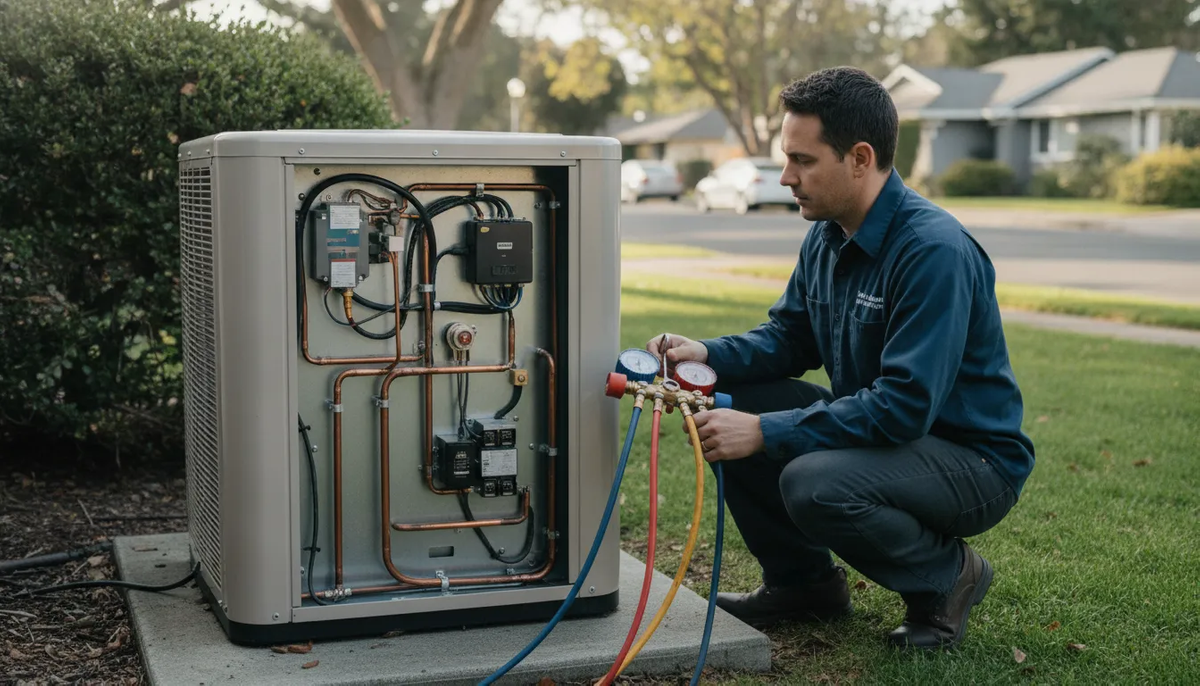
A heat pump that heats but will not cool, or cools but will not heat, often points to the reversing valve. Heat pump reversing valve repair is a job for a licensed technician, not a homeowner with a wrench. The valve sits in the outdoor unit and flips refrigerant flow so one system can heat and cool. A bad coil, a stuck slide, or a true leak all feel the same indoors. They do not cost the same to fix.
Request a heat pump repair visit.
This guide covers what the valve does and the signs that it is failing. It also covers what a proper diagnosis checks first. Then it covers how Bay Area homeowners decide between a valve repair and a new heat pump. City repair guides cover local service. This article stays on the valve itself.
What the reversing valve does
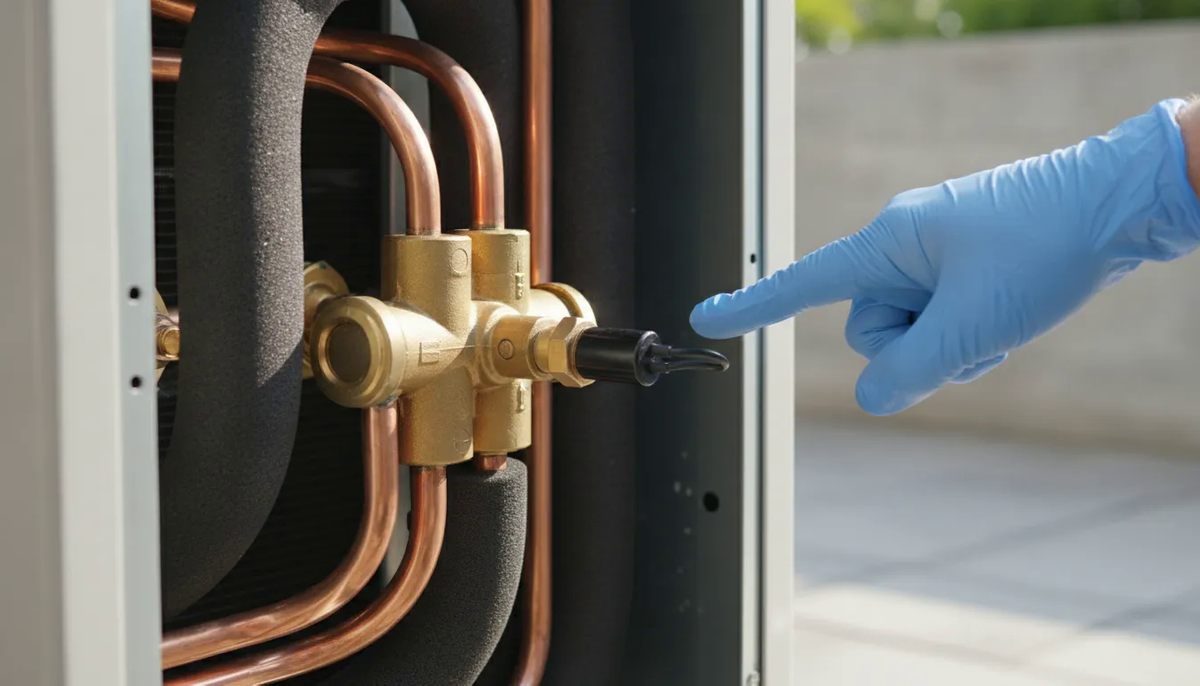
An air-source heat pump moves heat. In cooling, the indoor coil absorbs heat and the outdoor coil releases it. In heating, those jobs swap. The reversing valve, also called a four-way valve, makes that swap by changing the direction of refrigerant flow.
The valve body has four main ports. One port always takes hot gas from the compressor discharge. The center suction port always returns refrigerant toward the compressor, often through an accumulator. The other two ports feed the indoor and outdoor coils. A small pilot solenoid slides an internal piston so those two coil ports trade places.
On most residential systems the solenoid is energized in cooling and rests in heating. Some brands do the opposite. The energized position depends on the design. The thermostat O or B terminal tells the valve which way to sit. A thermostat set to the wrong reversing logic can imitate a dead valve. That is why the first check is electrical, not a part swap.
The valve also shifts during defrost. Outdoor frost is normal on a cold, damp Bay Area morning. A short defrost cycle that ends and returns to heat is healthy. A system that stays in cool, or never leaves heat while the outdoor coil ices over, is a different problem. Cold-weather operation, including normal defrost, is covered in our California cold-weather heat pump guide.
Signs you may need heat pump reversing valve repair
One bad afternoon is not a diagnosis. Filters, a tripped breaker, and a thermostat left on emergency heat all produce weak comfort. The pattern below is what usually sends a technician to the valve.
Stuck in one mode. The system heats well and will not cool, or the reverse. Changing the thermostat mode and waiting several minutes does not fix it.
Supply air that is only slightly off. Air is lukewarm in heat or not truly cold in cool. A valve that leaks internally mixes hot discharge gas into the suction side, so both modes feel weak.
A click with no change. You hear the solenoid click at the outdoor unit when you switch modes, but the supply-air temperature does not change. The coil is working and the slide is not.
A steady hiss at the valve. A brief whoosh during a mode change is normal. A constant hiss plus poor comfort can mean internal bypass.
Outdoor coil behavior that does not match the mode. In heat, the outdoor coil should get cold. If it stays warm while the indoor air is cool, flow may not have reversed.
Bills that jump without a setpoint change. A valve stuck so the system leans on electric strip heat will run, but it will cost more. Strip heat is resistance heat. It is not the heat pump doing its job.
None of these signs prove the valve body is bad. A low refrigerant charge can keep a valve from shifting fully. A failed defrost board can lock the call for heat. An open solenoid coil is a much smaller repair than a new valve. Treat the list as a reason to call, not as a parts order.
What a technician checks before replacing the valve
Good heat pump reversing valve repair starts by ruling out cheaper faults. A coil, a control board, or a thermostat setting can mimic a seized valve. Replacing the valve first wastes the refrigerant charge and a full day of labor.
Electrical signal and the solenoid coil
The technician confirms which mode should energize the coil, then measures voltage at the coil leads. Many systems use 24 volts. Some use line voltage. A coil that is warm is energized. A coil that should be energized and is cold and open on an ohm check is a failed coil. Coil replacement is often a parts-and-labor visit, not an open-refrigerant repair.
They also confirm the thermostat. The O terminal usually energizes cooling-default valves. The B terminal usually energizes heating-default valves. A new thermostat programmed for the wrong brand logic will call for cool and get heat. That is a settings fix, not a valve.
Pressures and pipe temperatures
With the compressor running, gauges and a temperature clamp tell the story the ears cannot. On a healthy valve, the discharge line into the valve is hot and the suction line leaving it is cool. The two coil lines should be clearly different from each other. A small temperature gap between suction and the coil line that should match it often means hot gas is leaking across a worn slide.
Field training uses that temperature split and the system pressures to separate a stuck valve from a weak compressor or a low charge. The exact numbers belong on the manufacturer's charging chart for that model. A homeowner gauge set without that chart is how systems get overcharged.
Charge, defrost, and airflow
Low charge can leave the valve short of the pressure difference it needs to slam the slide home. Finding and repairing a leak, then weighing in the correct charge, sometimes restores shifting without a new valve. The defrost board and sensors get the same pass. So do filters, indoor coil cleanliness, and closed supply vents. Those faults change temperatures and can frame an innocent valve.
Ortiz technicians document the readings before recommending parts. If the visit is a repair diagnosis rather than new equipment, a service fee applies. Estimates for replacing or adding equipment are a separate conversation. You can see how that visit is scoped on the HVAC repair page and the heat pump service page.
Repair or replace the valve
Once the valve is confirmed, the choice is usually coil only, valve body, or full system. There is no honest flat price. Access, refrigerant type, and system age move the bill more than the brass part does.
Coil only
If the coil is open, shorted, or not receiving voltage for a known reason, replacing the coil leaves the refrigerant circuit closed. This is the repair you hope for. It is also the one a careful diagnosis is built to find.
Valve body
A stuck slide, a leaking piston, or a valve that will not hold a position needs the body replaced. The job is an open-refrigerant repair. A certified technician recovers the charge and cuts out the old valve. The new valve is brazed in with nitrogen flowing, along with a bi-flow filter-drier. The system is then pressure-tested, evacuated, and charged by weight. Accessible split systems often take the better part of a day. Tight attic, rooftop, or package units take longer and may need two people.
Published ranges vary because the jobs vary. Trane has described typical reversing-valve replacement around $400 to $700. Local labor changes that figure. Other contractor guides put a full job, including refrigerant and labor, from roughly $400 to $1,500. Some complex jobs land higher. Treat every figure as a national range, not an Ortiz quote. Your invoice should list the valve model, refrigerant type, pounds weighed in, and the vacuum level reached.
When a new heat pump is the better buy
Ask for a side-by-side when any of these are true.
The outdoor unit is past about 12 to 15 years, which is a common service life for the valve and the compressor together.
The compressor is noisy, tripping, or showing poor compression on the same visit.
The system uses an older refrigerant that is expensive or scarce to replace by the pound.
The cabinet is corroded from salt air along the Peninsula or San Francisco Bay, so new brazed joints sit in a rusty box.
The valve repair approaches half the cost of a matched replacement, before local rebates.
A valve repair on a tired system can be the right call if the compressor is strong and the indoor air handler is newer. It is the wrong call if you are about to pay for refrigerant twice. Replacement planning and sizing live on other pages, including the installation service page and our note on whether annual heat pump maintenance is worth it.
What the repair visit actually includes
Homeowners sometimes expect a valve to be "unstuck" with a magnet or a tap. A light tap is an old field trick and it is not a repair. If the slide frees and then sticks again, the piston and seals are already worn. Opening the system to experiment is how moisture and acid get into the compressor.
A proper valve replacement follows a set order:
Confirm the electrical call, coil, charge, and defrost controls so the valve is actually the fault.
Recover the refrigerant. Venting it is illegal under EPA Section 608.
Protect nearby wiring and the compressor from torch heat, then cut out the old valve.
Braze the new valve in the orientation the manufacturer specifies, while purging with nitrogen so scale does not form inside the pipe.
Install a new bi-flow filter-drier. A one-way drier is the wrong part on a heat pump.
Pressure-test with nitrogen, pull a deep vacuum, and confirm the vacuum holds.
Charge by weight from the data plate, then check superheat or subcooling against the charging chart.
Run both modes and a defrost, and record temperatures before leaving.
The U.S. Environmental Protection Agency prohibits intentional release of refrigerant during air-conditioning repair. Narrow exceptions exist, such as tiny loss when connecting hoses. That rule is why this is not a Saturday DIY project. The statute sits in Section 608 of the Clean Air Act. The service rules are summarized by the EPA's venting prohibition. Technicians who recover and charge refrigerant need Section 608 certification.
Bay Area homes add a few local wrinkles. Marine air from Pacifica through San Francisco corrodes outdoor cabinets and electrical plugs. A coil that tests fine in October can fail after a wet winter. Hill houses in Oakland, Berkeley, and Daly City often put the heat pump on a tight side yard or a roof. That adds labor before anyone opens a fitting. Older San Mateo County houses may have long line sets. A valve repair does not fix undersized ducts or a line set that is too small. If airflow is the limit, say so before the torch comes out. Ortiz serves San Francisco, San Mateo, Alameda, and Contra Costa counties from Burlingame, under California license 803346.
How to avoid a repeat failure
A new valve fails early for a short list of reasons. Moisture left in the system, a skipped filter-drier, scale from brazing without nitrogen, or a charge that was never weighed. Those are workmanship items. You can ask for them on the invoice.
The other causes sit with the system around the valve:
Dirty filters and a packed outdoor coil. High head pressure and poor oil return stress every moving part, including the slide.
Low charge from a slow leak. The valve may shift poorly long before the compressor fails. Leak search belongs in the same visit.
Short cycling. A system that starts and stops every few minutes keeps slamming the valve. Thermostat placement, refrigerant charge, and airflow are the usual causes.
Skipped maintenance. Fall and spring checks catch a weak capacitor, a stuck contactor, and a coil that is headed open. They cost less than an open-refrigerant repair.
Coastal and East Bay homes both benefit from a rinse of the outdoor coil and a look at the control plug. Salt film and wet leaves are local, not generic. If you want that on a schedule, start with heat pump maintenance rather than waiting for a no-heat night. For symptoms that may not involve the valve, the Oakland heat pump repair guide walks through diagnosis without assuming this one part.
Keep the outdoor unit clear by a couple of feet. Leave the disconnect on unless a technician asks you to shut it off. Do not hose electrical components. Change the indoor filter on the schedule for your filter type. If the system blows the wrong temperature for more than a day, turn emergency heat off so strip heaters are not masking the fault. Then book a diagnostic.
Talk with Ortiz about a reversing valve diagnosis
Compare the three repair paths
Use this as a planning sketch. It is not a quote. Ortiz confirms the path only after voltage, temperature, and pressure readings.
Solenoid coil only. The coil is open, shorted, or not powered. The slide still moves. What changes: The coil, and sometimes the plug. Usual cost shape: The smallest bill. Refrigerant stays sealed.
Valve body. The slide sticks or leaks after the coil, charge, and board check out. What changes: The valve, a filter-drier, and a weighed refrigerant charge. Usual cost shape: National guides often cite about $400 to $1,500.
New heat pump. The compressor is weak, the unit is old, or the valve job nears half a replacement. What changes: Matched outdoor and indoor equipment. Usual cost shape: A replacement quote. New equipment can use a free estimate.
Frequently asked questions
How much does heat pump reversing valve repair cost?
A failed solenoid coil is the small repair. Replacing the valve body is the large one, because the refrigerant must be recovered, the pipes brazed, and the system evacuated and recharged. Published national ranges often run from a few hundred dollars into the $1,500 area, and tight access or a large charge can go higher. Ortiz prices the job after readings, not from a national average. Repair visits are diagnostic service, not a free estimate. Free estimates apply when you are replacing or adding equipment.
Can a stuck reversing valve be fixed without replacing it?
Sometimes a slide that has not seated will shift once pressures and the coil are corrected, or after a careful field check. If it sticks again, the internal piston is worn and the valve body should be replaced. Tapping the valve is not a lasting fix, and it is not something to try with the cabinet open around live voltage and refrigerant lines.
How do I tell a bad reversing valve from a bad compressor?
You usually cannot from the thermostat. A compressor that has lost compression runs and still fails to heat and cool. A valve problem is more often one mode that works and one that does not, or both modes that run with crossed temperatures. A technician compares pipe temperatures across the valve and compressor pressures. Those two tests separate the parts.
Is it safe to keep running the heat pump if the valve is stuck?
Running in the mode that still works will not always ruin the system that day. A valve that bypasses hot gas into the suction line can overheat the compressor. Electric strip heat can carry you through a cold night at a higher bill. Shut the system off if you smell overheating, the breaker trips, or the outdoor unit ices solid and never defrosts. For same-day help, use the HVAC service call page.
Who should repair a reversing valve in the Bay Area?
Hire a licensed contractor whose technicians hold EPA Section 608 certification and will recover refrigerant rather than vent it. Ask them to rule out the coil, thermostat logic, charge, and defrost board before they quote a valve. Ortiz Heating and Air Conditioning diagnoses and repairs heat pumps across the Peninsula, San Francisco, and the East Bay.
Get a clear diagnosis before you replace anything
A reversing valve is a small part with a large labor bill. It is often blamed for faults that live in the coil, the thermostat, or the refrigerant charge. The useful next step is a measured diagnosis. That means voltage at the solenoid, temperatures on all four pipes, and a decision you can compare with the age of the outdoor unit.
Ortiz Heating and Air Conditioning has served Bay Area homes from Burlingame since 1999, with in-house technicians and California license 803346. If your heat pump is stuck in one mode, request a visit and we will tell you whether the valve, a smaller part, or a replacement conversation is the honest answer.