
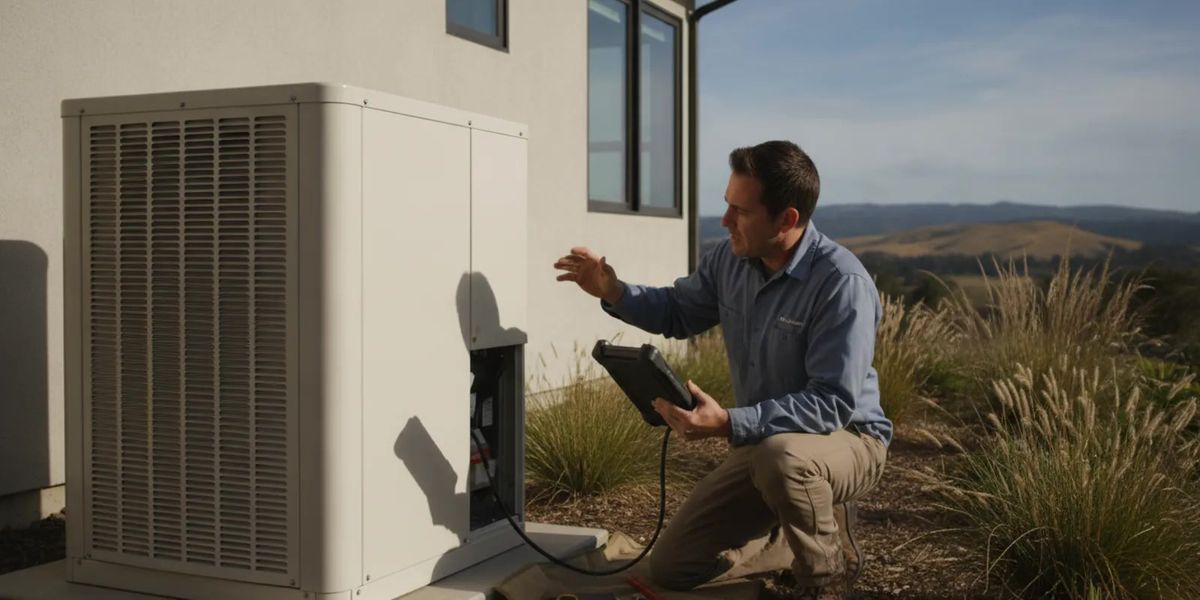
If your system is running but your Oakland home is not getting comfortable, the cause may be as simple as a blocked filter or as complex as an electrical or refrigerant problem. This guide to heat pump repair Oakland homeowners can use explains what to notice, what you can safely check, and what a professional diagnostic visit may involve.
Contact the HVAC team about your heat pump
Which heat pump symptoms should Oakland homeowners notice?
Heat pumps move heat rather than generating it in the same way as a furnace. They can provide both heating and cooling, so a problem may show up in either mode. Note what the system is doing, when it happens, and whether the issue affects the whole home or just one area. Those details help focus the diagnosis.
Weak airflow: Air from the vents feels faint, or some rooms receive much less air than others. A dirty filter, obstructed return, blower issue, duct problem, or other condition may be involved.
Air that does not feel warm or cool enough: The system may be operating but not meeting the thermostat setting. Check whether the outdoor unit is running and whether the issue occurs in heating, cooling, or both.
Frequent cycling or unusually long run times: The system starts and stops more often than usual or runs for a long time without reaching the set temperature. Control settings, airflow, equipment condition, or the home's heat gain and loss can all matter.
Unusual noise or vibration: A new rattling, buzzing, grinding, or scraping sound deserves attention. A brief change in sound can have a different cause from a persistent or worsening noise.
Ice that remains on the outdoor coil: Some frost may occur during heating, and a heat pump may periodically run a defrost cycle. A thick layer of ice that does not clear, or ice accompanied by poor heating, should be evaluated.
Water near the indoor unit: A small amount of condensate drainage can be normal in some operating conditions. A leak, overflow, or water near electrical components is not something to ignore.
A sudden change in energy use or comfort: If the system's pattern changes without an obvious thermostat adjustment, record when the change began and whether it coincided with a power interruption or other event.
One symptom rarely identifies a single failed part. For example, weak heating can result from airflow restrictions, a control problem, a defrost issue, or a fault in a major component. A qualified technician needs to test the system rather than guess from the symptom alone.
Patterns can make the initial description more useful. If the problem appears only in the morning, note whether the thermostat schedule changes then. If one bedroom stays uncomfortable while the rest of the home responds normally, record that contrast rather than describing the entire system as ineffective. When noise is the main concern, note whether it occurs as the unit starts, runs, or shuts down. These observations do not diagnose the fault, but they help distinguish a recurring condition from a one-time change.
What can you check safely before requesting heat pump repair?
A few simple observations can help rule out basic operating issues. Stop if a check would require opening an equipment panel, reaching near moving parts, handling wiring, or working on a roof or ladder. Do not remove ice with a tool, pour hot water on the unit, or attempt to adjust refrigerant components.
Confirm the thermostat mode and setting. Make sure it is set to heat or cool as intended, and that the target temperature is not already satisfied. If the thermostat has a schedule, check whether it changed the set point.
Check the air filter. If the filter is visibly loaded with dust, replace it with the correct size and type for the system. Follow the equipment instructions for the filter's direction and replacement interval. A filter that is too restrictive or installed incorrectly can also affect airflow.
Look for blocked supply and return vents. Move furniture, rugs, or curtains away from grilles. Do not close many vents to force more air into another room; this can disrupt system airflow.
Look at the outdoor unit from a safe distance. Clear leaves or loose debris around the unit if you can do so without moving or opening anything. Keep the manufacturer's required clearance around it. Do not reach through the grille or remove a panel.
Notice the operating pattern. Record whether the indoor fan runs, whether the outdoor unit starts, how long the system operates, and which rooms feel affected. Do not repeatedly switch the system off and on to test it.
Check for a tripped breaker only if it is safe and familiar. If a breaker trips again after a reset, leave it off and contact a professional. Repeated trips can indicate a fault; do not keep resetting it.
For instance, write down: “Heating mode, set to 70, living room feels comfortable, back bedroom remains cool, outdoor unit runs for about 20 minutes, and the filter was changed last week.” That is more actionable than “the heat pump is broken.” If the symptom comes and goes, make a short log with the time and operating mode rather than changing several settings at once. Changing one variable at a time can help you describe the behavior accurately without trying to repair the equipment yourself.
Turn the equipment off and seek prompt help if you smell burning, see smoke or sparks, hear a loud electrical pop, or find water contacting electrical components. If a carbon monoxide alarm sounds, leave the home and follow emergency guidance; do not treat it as a routine HVAC call. For broader system questions, see the company's heat pump services and repair services.
What may happen during a heat pump diagnostic visit?
A useful diagnostic visit starts with your description of the problem and the system's recent behavior. Share the thermostat setting, when the symptom began, any recent power outage, and checks you have already tried. Mention whether the issue appears in heating, cooling, or both. If one room is affected more than others, point it out.
The technician can then inspect and test relevant parts of the system. Depending on the symptoms and equipment, the visit may involve checking thermostat operation, airflow, the indoor and outdoor equipment, electrical connections and controls, coil condition, condensate drainage, and system operating measurements. Not every visit requires every test; the findings guide the next step.
Heat pumps use different configurations and operating strategies. Research on residential integrated heat pump designs and field trials for cold-climate homes illustrates why a system's configuration matters when considering how it should operate (Oak Ridge National Laboratory research on residential integrated heat pumps). A residential air-source heat pump optimization study likewise examines how equipment design affects system performance (U.S. Department of Energy research on residential air-source heat pump optimization). These studies are not repair manuals, but they reinforce why diagnosis should be based on the particular equipment and measured operation, not a one-size-fits-all assumption.
Ask the technician to explain what was checked, what the results indicate, and which options are available. For a repair, request a clear description of the work and applicable charges before authorizing it. Diagnostic and repair charges are not necessarily free. If replacement is being considered, ask for a separate installation estimate and what the proposed system includes.
You can also ask how the technician reached the conclusion. For example, if a control or sensor is suspected, ask what observation or test pointed to it and whether the other likely causes were ruled out. Before approving a repair, confirm whether the quoted scope covers parts, labor, and any follow-up testing, and ask what happens if the initial repair does not resolve the symptom. The purpose is not to direct the technical work, but to understand the recommendation and make an informed decision.
Which repair categories can cause heat pump symptoms?
Symptoms can point toward several broad categories. The table below is a starting point for understanding the conversation, not a substitute for testing or a prediction that a particular part has failed.
Low airflow at multiple vents: Filter, blower, return path, or duct airflow; Check the filter and keep vents clear; report which rooms are affected.
System does not respond to thermostat: Thermostat setting, controls, power, or wiring; Confirm mode and schedule; do not open control compartments.
Outdoor unit does not run: Power supply, controls, wiring, or equipment fault; Note whether the indoor fan runs; do not repeatedly reset a tripped breaker.
Cooling or heating is weak: Airflow, coil condition, refrigerant circuit, controls, or capacity-related issue; Record the mode and duration; leave sealed refrigerant components to a technician.
Persistent ice or poor heating in cold weather: Defrost operation, airflow, sensor or control issue, or another operating fault; Do not chip away ice; note whether it clears during normal operation.
Water around indoor equipment: Condensate drain or drainage-related issue; Turn off equipment if water threatens electrical components and request service.
New buzzing, grinding, or repeated breaker trips: Electrical, motor, fan, or mechanical issue; Stop operation if there is a safety concern and arrange professional evaluation.
Some work is straightforward once the cause is confirmed. Other repairs may involve specialized tools, electrical testing, refrigerant handling, or access to sealed equipment. Refrigerant work should be handled by a qualified professional. Avoid online advice that suggests adding refrigerant without finding and addressing the underlying issue.
The same symptom may lead to different tests depending on what else is happening. For example, a system that runs without reaching the set point may have restricted airflow, but a technician may also need to evaluate controls and operating measurements. Ice can be a clue, but the key questions include how much has formed, whether the defrost cycle clears it, and whether airflow or another operating condition is contributing. Treating one visible sign without finding its cause can leave the original comfort problem in place.
How should you compare a repair with heat pump replacement?
A repair-versus-replacement decision depends on the equipment's condition and the home's needs, not only the age of the system or a single repair quote. Consider the pattern over time: Has the unit needed repeated work? Does it maintain comfort across the home? Are parts available? Does the proposed repair address the root cause, or only one symptom?
It can help to compare options in writing:
Repair scope: Ask what failed, how it was verified, what the repair includes, and whether further work could be needed if testing reveals another issue.
System condition: Consider the condition of both indoor and outdoor equipment, not just the component currently causing trouble.
Comfort and airflow: Note persistent room-to-room differences, noise, or inability to maintain the desired temperature.
Operating needs: Think about how you use heating and cooling, any planned home changes, and whether the existing system fits those needs.
Replacement scope: Compare equipment selection, duct or electrical work, controls, permits, and commissioning steps in an installation proposal.
Replacement may be worth discussing when repairs recur, a major component has failed, the system no longer meets comfort needs, or equipment condition makes continued repair uncertain. None of these signs alone requires replacement. Ask for the reasoning behind both paths, including the expected limitations and costs. Ortiz offers a separate HVAC installation service for homeowners exploring a new system. For planning, see the Bay Area heat pump sizing guide and the comparison of mini-split and ducted heat pumps.
A practical comparison separates immediate expense from the larger decision about the home. Ask what happens if you choose the repair: which comfort issues should it resolve, what condition will remain, and what future work is uncertain? For replacement, ask what equipment is included, whether the existing ducts or electrical service need changes, and how the installer verifies operation after startup. Compare complete written scopes rather than a repair line item against an incomplete replacement figure. If the repair solves the current fault and the rest of the system is in suitable condition, that may be reasonable; if recurring problems or comfort limitations remain, include those in the discussion too.
How can Oakland homeowners prepare for a service visit?
Good notes make a service visit more focused. Before the appointment, gather the model information if it is easy to access without removing a panel. Photograph the thermostat display or visible ice or water if conditions allow, and list any unusual sounds. Do not delay an urgent safety response just to collect information.
Write down the date the issue began and whether it is constant or intermittent.
Record indoor temperatures or rooms affected, along with the thermostat mode and setting.
Share recent filter changes, power interruptions, or changes to the home that may affect airflow.
Make a clear path to the thermostat, indoor unit, and outdoor unit, without moving equipment or disconnecting anything.
Ask what the diagnostic charge covers and request approval before additional work.
Oakland homes are part of a broader East Bay area with varied building layouts and comfort needs. Ortiz lists service information for the East Bay Area and Alameda County, as well as its San Francisco Bay Area coverage. If your concern involves a business rather than a home, the company's commercial HVAC services page outlines its commercial service area.
For systems that are operating normally but need routine attention, learn what preventive work may involve through the company's HVAC maintenance services. Maintenance does not replace diagnosis when a fault is already present, but a record of service can help provide context.
Review repair service options for your heat pump
Frequently Asked Questions About Heat Pump Repair in Oakland
Can I keep running a heat pump that is not heating well?
If there is no safety concern, you can note its behavior while arranging an evaluation, but avoid extended operation if it is making unusual noises, repeatedly tripping a breaker, or developing persistent ice. Turn it off and seek prompt help for smoke, burning odors, sparks, or water near electrical parts.
Is frost on an outdoor heat pump always a sign of a problem?
No. Some frost can form during heating, and a heat pump may use a defrost cycle. Thick ice that remains, keeps returning quickly, or comes with poor heating deserves professional evaluation. Do not scrape or chip the coil.
Can I add refrigerant to improve heating or cooling?
No. Refrigerant is part of a sealed system, and a low charge can indicate a problem that needs diagnosis. A qualified technician should test the system and determine the appropriate repair rather than adding refrigerant as a guess.
Are heat pump diagnostics or repair estimates free?
Do not assume so. Ask about the diagnostic charge and the scope of the visit before scheduling. A free estimate applies to new equipment installation or replacement, not automatically to a repair diagnosis.
Plan your next step for heat pump repair in Oakland
Contact Ortiz Heating and Air Conditioning to discuss your heat pump concern
Write down the symptoms and any safe checks you have completed, then share those details when you arrange service so the system can be evaluated based on what it is actually doing.