
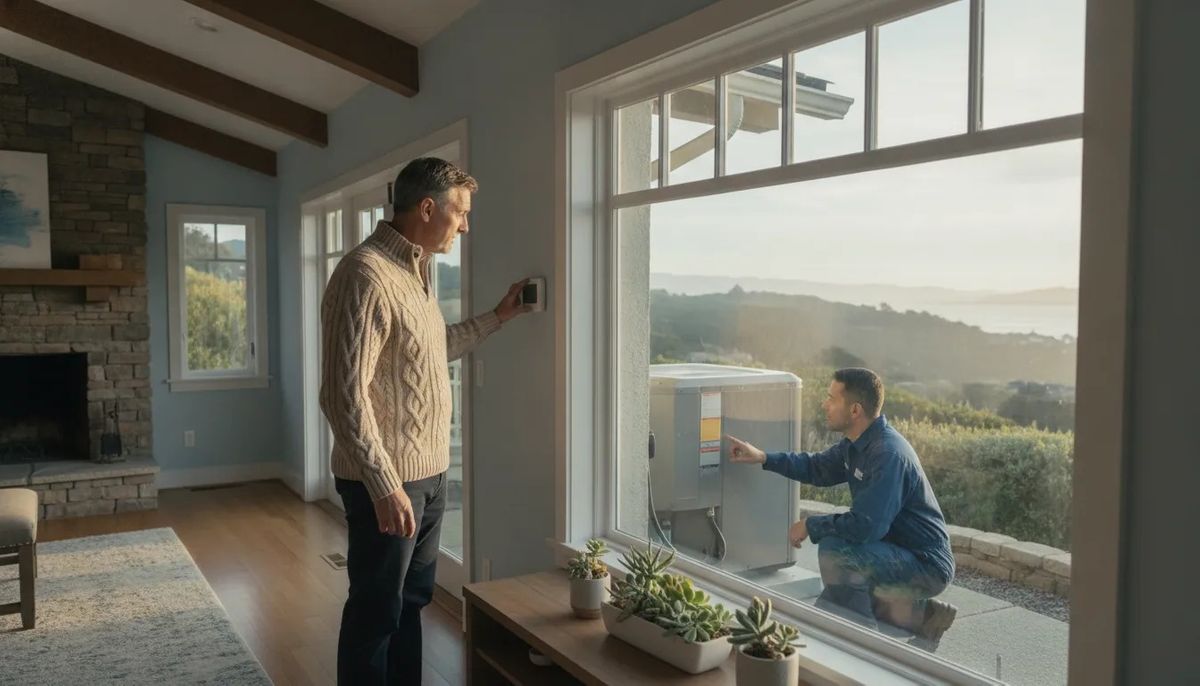
A chilly Bay Area morning can raise a reasonable question: if a heat pump relies on outdoor air, how can it keep a home comfortable when temperatures fall? The answer depends on understanding heat transfer, not the familiar idea that heating requires combustion. Outdoor air still contains thermal energy in cold conditions, while the system's refrigerant cycle is designed to absorb and move that energy indoors.
In practical terms, how does a heat pump work in cold weather california? It uses electricity to transfer available heat from outside into the home, with performance changing according to outdoor conditions, equipment design, sizing, insulation, and ductwork. Modern air-source technology can operate in colder climates, but no single temperature limit or system size fits every property. The EPA explains that heat pumps both transfer heat and provide cooling.
That makes the details of the refrigerant cycle especially useful for homeowners in San Francisco, San Mateo, Alameda, and Contra Costa counties. Once the basic process is clear, it becomes easier to understand cold-weather efficiency, defrost operation, and why a properly evaluated home feels more consistently comfortable.
Explore Bay Area heat pump services
How Does a Heat Pump Work in Cold Weather California Homes?
How does a heat pump work in cold weather California homes? It uses electricity and a refrigeration cycle to move available heat from outdoor air into the house. Even cold air contains some heat energy, so the system can absorb it rather than relying on combustion to create heat. The exact comfort and efficiency you experience depend on the equipment, the home, and the local microclimate, but the basic process remains consistent.
The outdoor coil collects available heat
In heating mode, refrigerant travels through the outdoor coil at a low pressure. Because the refrigerant is colder than the surrounding outdoor air, it can absorb heat from that air, even when the weather feels chilly. The refrigerant changes from a liquid into a gas as it takes in thermal energy. This is the first important point for homeowners: the heat pump is not making warmth from nothing. It is gathering and relocating heat that is already present outside.
ENERGY STAR explains that refrigerant can absorb available heat at low pressure, including heat that remains in very cold outdoor air. Read the ENERGY STAR explanation of how heat pumps work for a more detailed look at the cycle.
The compressor raises pressure and temperature
After absorbing heat, the refrigerant gas moves to the compressor. The compressor squeezes the gas, increasing its pressure and temperature. This step makes the captured heat warm enough to transfer into the home. The hot, high-pressure refrigerant then flows toward the indoor coil.
The indoor coil releases heat into the home
At the indoor coil, air from the house passes across the warmed refrigerant tubing. Heat moves from the refrigerant into the indoor air, and a blower distributes that air through the ductwork or into the room through a ductless indoor unit. As the refrigerant gives up heat, it condenses back into a liquid. It then passes through the system's expansion device, drops in pressure, and returns to the outdoor coil to collect more heat.
The cycle repeats as long as the thermostat calls for heat. A ducted heat pump may work with suitable existing central-air ducting. A ductless mini-split can provide another configuration for a home without ducts. The right arrangement depends on the property's layout and existing equipment.
The reversing valve changes the system for summer
A heat pump can also cool the home. Its reversing valve changes the direction of refrigerant flow, so the indoor coil absorbs heat from the house and the outdoor coil releases that heat outside. The same core components then support both heating and cooling, rather than requiring two separate refrigerant systems. EPA describes heat pumps as systems that transfer thermal energy and provide both space heating and cooling. See the EPA overview of heat pumps for additional background.
The outdoor coil absorbs available heat from outdoor air.
The compressor raises refrigerant pressure and temperature.
The indoor coil releases heat into the living space.
The reversing valve redirects the cycle for summer cooling.
Because Bay Area conditions vary between coastal and inland communities, a system should be selected and configured for the home's insulation, ducts, layout, and expected heating demand. Cold-weather operation is a capability of the equipment, not a promise that every model will perform identically in every house.
What Changes When Outdoor Temperatures Drop?
A heat pump can continue extracting heat from outdoor air as temperatures fall, but its performance does not remain exactly the same. The refrigerant system has less available heat to collect, and the equipment may need to run longer or work harder to maintain the indoor setpoint. That does not mean there is one temperature at which every heat pump stops working.
Delivered heating capacity is equipment-specific. A unit's model, controls, installation, sizing, and operating conditions all affect how much heat it can provide at a given outdoor temperature. Cold-climate technology has expanded the range in which air-source heat pumps can serve as effective heating systems. The Environmental Protection Agency notes that newer technology can perform in cold climates, including conditions around 5 degrees Fahrenheit and colder. That is evidence of what properly selected equipment can do, not a universal cutoff for every home or product. The EPA explains heat pump cold-weather capability in more detail.
Why capacity and efficiency change
As outdoor temperatures drop, the system generally has less thermal energy available to move indoors. The heat pump may operate for longer periods, and the amount of heat delivered per unit of electricity can change. A system that is comfortably meeting the load during a mild Bay Area afternoon may have less reserve during a colder overnight period. Longer operation is not automatically a fault. Heat pumps are designed to provide steady heat, rather than switching on briefly with the same pattern as many conventional furnaces.
Efficiency also has a practical cost component. Electricity prices vary by utility territory and rate plan, so operating cost cannot be predicted from efficiency alone. The relative cost of electricity and fossil fuels can affect the financial comparison, even when a heat pump uses energy efficiently. Homeowners should evaluate expected performance alongside their actual utility rates, not rely on a generic cost claim.
There is no universal answer to "how cold is too cold?"
Some tested cold-climate heat pumps have continued performing at temperatures as low as -15 degrees Fahrenheit. Rewiring America notes that this result applies to specific cold-climate equipment and testing conditions. It should not be used as a promise for an unspecified system. Rewiring America's cold-weather heat pump overview illustrates why the model's published performance data matters.
For San Francisco, San Mateo, Alameda, and Contra Costa counties, the relevant question is usually not a dramatic universal cutoff. Local microclimates, insulation, window exposure, property layout, and ductwork can change heating demand from one home to the next. Proper sizing and a review of the manufacturer's low-temperature ratings help determine whether the selected system can maintain comfort through the coldest conditions your property is likely to experience.
Factor.What it can change.What to review.Outdoor temperature.Available heat and equipment output.Published performance data for the selected model.Home envelope.How quickly rooms gain or lose heat.Insulation, windows, air leakage, and room layout.Air distribution.How evenly heat reaches occupied rooms.Duct condition, duct design, zoning, or indoor unit placement.
Why Does a Heat Pump Go Into Defrost Mode?
Frost can form on an outdoor heat pump coil during heating because the coil becomes cold as it draws heat from outdoor air. Moisture in that air can collect on the coil and freeze. A light layer of frost is not automatically a sign of a malfunction. The system is designed to recognize that condition and temporarily change how it operates so the outdoor coil can clear itself.
What happens during a defrost cycle?
A heat pump uses a refrigerant circuit and reversing valve to move heat in different directions. When its controls detect conditions consistent with frost buildup, they can initiate a temporary defrost cycle. The reversing valve changes the refrigerant flow, allowing warmer refrigerant to reach the outdoor coil. That heat melts the frost, then the system returns to heating mode. The exact control strategy varies by equipment, outdoor conditions, and installation, so there is no single interval or temperature threshold that applies to every heat pump.
During this brief change, the indoor unit may reduce or pause warm airflow. Some systems use supplemental heat during that transition to limit the delivery of cool air indoors. The outdoor fan may slow down or stop while the coil clears. You may also hear a noticeable change in compressor or refrigerant sound when the valve shifts. These changes can be normal when they are temporary and the system resumes regular heating afterward.
When is defrost behavior a service concern?
The important distinction is between a temporary, self-correcting cycle and frost that remains or returns with other performance problems. Pay attention if the outdoor coil becomes heavily encased in ice, if the system struggles to restore heat, or if indoor comfort steadily declines. Continuous water or ice buildup around the outdoor unit can also point to drainage, airflow, sensor, control, or refrigerant-related issues. A blocked filter, obstructed outdoor coil, or restricted airflow may make the system work harder and can complicate normal operation.
Do not chip ice from the coil with a tool or pour boiling water over the equipment. Those actions can damage fins, tubing, or electrical components. Keep leaves, furniture, and other obstructions away from the outdoor unit, and make sure melting water has a clear path away from its base. If unusual sounds, repeated shutdowns, persistent ice, or inadequate heating continue, a qualified technician can evaluate the equipment rather than treating the frost alone as the diagnosis.
Regular inspection helps identify airflow and component problems before they become larger comfort issues. Ortiz's guide to heat pump maintenance explains why checks of filters, coils, refrigerant, and electrical connections matter. Proper maintenance cannot eliminate every defrost cycle, but it can help the system respond reliably when Bay Area weather creates the conditions for frost.
How Do Sizing, Insulation, and Ducts Affect Comfort?
A heat pump can be well suited to Bay Area weather and still deliver disappointing comfort if the system is selected without understanding the home. The equipment must respond to the building's actual heating and cooling load, not simply its floor area. A load calculation and an inspection of the property help connect the equipment to the way the home gains and loses heat.
Property size is one part of that picture, but it is not the whole picture. Insulation levels affect how quickly rooms lose heat. Window exposure, ceiling height, additions, room arrangement, and the relationship between floors can create different comfort demands within the same house. Ortiz considers property size, insulation, and layout when recommending an HVAC system. Then uses that information to guide system selection rather than naming a capacity from square footage alone.
Building size and layout: Review the conditioned area, room arrangement, ceilings, additions, and any zones that may need separate control.
Insulation and air movement: Look at the building envelope and identify areas where heat can escape or outdoor conditions can influence indoor comfort.
Windows and exposure: Consider sunlight, shade, exterior orientation, and rooms that experience different conditions during the day.
Ductwork condition and design: Check whether existing ducts are appropriately arranged, accessible, and able to distribute conditioned air where it is needed.
Equipment configuration: Determine whether a ducted system, a multi-zone arrangement, or a ductless mini-split better matches the home's structure and comfort goals.
Ductwork deserves particular attention during a replacement. A ducted heat pump can often work with existing central-air ducting, as ENERGY STAR explains. That does not mean every existing duct system should be reused without inspection. The layout, condition, and distribution pattern can affect how evenly heated air reaches bedrooms, additions, and other distant areas. In some homes, duct redesign or a multi-zone system may be appropriate parts of the installation plan.
Homes without usable ductwork have another option. Ductless mini-splits use indoor units connected to an outdoor heat pump, allowing comfort control without extending a central duct network. They can be useful where a home lacks existing ducts or where individual areas have different needs. The right arrangement still depends on the home's layout and how occupants use each space. More indoor units are not automatically better, and one configuration should not be treated as a universal solution.
Bay Area conditions make this assessment especially important. Housing types and microclimates vary across San Francisco, San Mateo, Alameda, and Contra Costa counties. A coastal home, an inland property, and a partially remodeled house may present very different insulation and airflow challenges. Ortiz emphasizes a thorough assessment before system selection and provides transparent estimates before installation work begins. For a deeper planning overview, review this heat pump installation planning guide or explore the company's installation services. An assessment is the responsible way to determine capacity and configuration; no specific size should be recommended before those conditions are evaluated.
Review heat pump installation planning factors
What Should Bay Area Homeowners Expect in Winter?
Winter comfort in the Bay Area is less about reaching one universal outdoor temperature and more about matching the system to the home and its microclimate. A coastal or Peninsula home may experience damp, windy conditions and modest heating demand. While a home farther inland may see colder mornings, larger day-to-night swings, or more frequent heating cycles. San Francisco, San Mateo, Alameda, and Contra Costa counties also contain many different housing types, insulation levels, floor plans, and ductwork conditions. Those variables shape how a heat pump feels in daily use.
Comfort should feel steady, not dramatic
A properly selected and installed heat pump can maintain a comfortable indoor temperature through regular, measured operation. You may notice longer or more consistent heating cycles than with a furnace that delivers a short burst of very hot air. That is not automatically a problem. Heat pumps move heat into the home, so the supply air can feel different from furnace air while the room remains comfortable.
Thermostat behavior matters, too. Large temperature setbacks can prompt the system to run longer while it restores the indoor setting. Many households are more comfortable choosing a reasonable temperature and letting the system maintain it, rather than repeatedly turning the thermostat up and down. Actual results depend on the equipment, controls, insulation, windows, and the home's heat loss.
Airflow and sound depend on the design
Expect noticeable airflow from registers or indoor heads, but it should not feel like an unexplained draft in occupied spaces. Ducted equipment can use existing central-air ducting when that duct system is suitable. Ductless mini-splits can be a practical alternative for homes without ducts or for areas that need independent temperature control. You can review the available Bay Area heat pump services before deciding which arrangement fits your home.
Outdoor units make operating sounds, and indoor fans create some airflow noise. The acceptable sound level depends on placement, mounting, fan speed, and the equipment selected. A careful assessment should consider bedroom windows, neighboring properties, and rooms where quiet matters. Persistent rattling, unusual grinding, or a sudden change in sound deserves attention rather than being dismissed as normal operation.
Some homes may need supplemental heat or a different configuration
Backup or supplemental heat is not a sign that every heat pump is inadequate. It can be considered when a home has unusual heat loss, a challenging layout, limited electrical capacity, or occasional conditions that place extra demand on the system. In other cases, the better answer may be improved insulation, duct repairs, zoning, a ductless design, or equipment selected for the home's specific operating conditions.
There is no single Bay Area setup that fits every property. Ortiz evaluates property size, insulation, and layout when recommending an HVAC system. The company's heat pump versus gas furnace guide can help frame the broader decision, while a site-specific evaluation determines what steady winter comfort should realistically look like in your home.
When Should You Schedule a Heat Pump Assessment?
An assessment is useful whenever comfort, equipment condition, or future planning raises questions that a thermostat reading cannot answer. In the Bay Area, homes in San Francisco, San Mateo, Alameda, and Contra Costa counties can have very different microclimates, insulation levels, layouts, and ductwork. A system that feels adequate in one property may be poorly matched to another.
Plan before a replacement becomes urgent
If your heat pump is aging, frequently needs service, or struggles during colder weather, schedule an assessment before it stops working. Planning early gives a technician time to evaluate the home's heating and cooling needs, review the existing system, and discuss replacement options without making a rushed decision. Ortiz considers property size, insulation, layout, and other installation factors before recommending an HVAC system. That evaluation helps connect equipment selection to the way the home actually gains and loses heat.
An assessment also makes sense during a remodel, addition, or major change in occupancy. New rooms, altered windows, improved insulation, or a converted garage can change airflow and capacity requirements. Homes without usable ductwork may need a ductless configuration, while a replacement central system may be able to use existing ducting if the ducts are in suitable condition. See the Bay Area heat pump services page for service and system options.
Pay attention to comfort and operating clues
Uneven room temperatures, weak airflow, long or nearly continuous runtimes, and repeated thermostat adjustments are reasons to investigate. These symptoms can relate to filters, ductwork, refrigerant levels, electrical connections, controls, system sizing, or the building envelope. They do not identify one guaranteed fault on their own. A professional assessment can separate an equipment problem from an airflow or insulation concern.
Visible frost that does not clear, unusual behavior during defrost, or a noticeable loss of heating performance also warrants attention. Some frost and temporary changes in operation can be part of normal heat pump control, but persistent icing or declining comfort should not be ignored. Avoid covering the outdoor unit or attempting to force a defrost cycle. A technician can inspect the system safely and determine whether maintenance or repair is appropriate.
Use maintenance as preventive planning
Routine maintenance is another good time to review system performance, especially before the heating season. Ortiz maintenance inspections include filters, ductwork, refrigerant levels, electrical connections, and other system components. Preventive checks can identify developing issues, support reliable operation, and help preserve efficiency. If the visit is for a repair or diagnostic problem, the service call carries a fee. Free estimates apply to equipment installation or replacement, not repair troubleshooting. For a planned installation or replacement assessment, homeowners can request an equipment replacement estimate.
Frequently Asked Questions
How cold is too cold for a heat pump to work?
There is no universal cutoff for every heat pump. Outdoor air still contains usable heat at low temperatures, and modern cold-climate models can operate in conditions that were once difficult for air-source systems. The practical limit depends on the equipment's design, rated capacity, home heat loss, and control strategy. A professional load assessment is more useful than relying on a general temperature rule.
Can heat pumps handle extreme cold weather?
Many cold-climate heat pumps are designed for very low outdoor temperatures. The U.S. Environmental Protection Agency says recent technology has made air-source heat pumps effective in colder climates, including temperatures of 5 degrees Fahrenheit and colder: EPA heat pump guidance. As conditions change, delivered capacity and efficiency may also change, so some homes use supplemental heat as part of the system design.
Why does a heat pump stop heating briefly in winter?
The outdoor coil can collect frost during cool, damp weather. When sensors and controls detect conditions that require it, the system enters defrost mode and temporarily changes operation to clear that frost. A brief change in sound or airflow can be normal. Persistent weak airflow, long interruptions, or inadequate indoor comfort should be evaluated by a qualified technician.
How do insulation and ductwork affect heat pump comfort?
Heat pump performance depends on the whole home, not just the outdoor unit. Gaps in insulation, air leakage, poor duct condition, and an incorrect system size can increase heat loss and create uneven rooms. In a Bay Area home, the right approach also considers local microclimate, layout, and whether a ducted or ductless configuration better distributes conditioned air.
Ready to Plan the Right Heat Pump Installation?
Bay Area homes and businesses can have very different heating needs based on their microclimate, insulation, layout, and existing ductwork. A property-specific assessment helps clarify which heat pump configuration can support steady comfort and practical operation through changing winter conditions.