
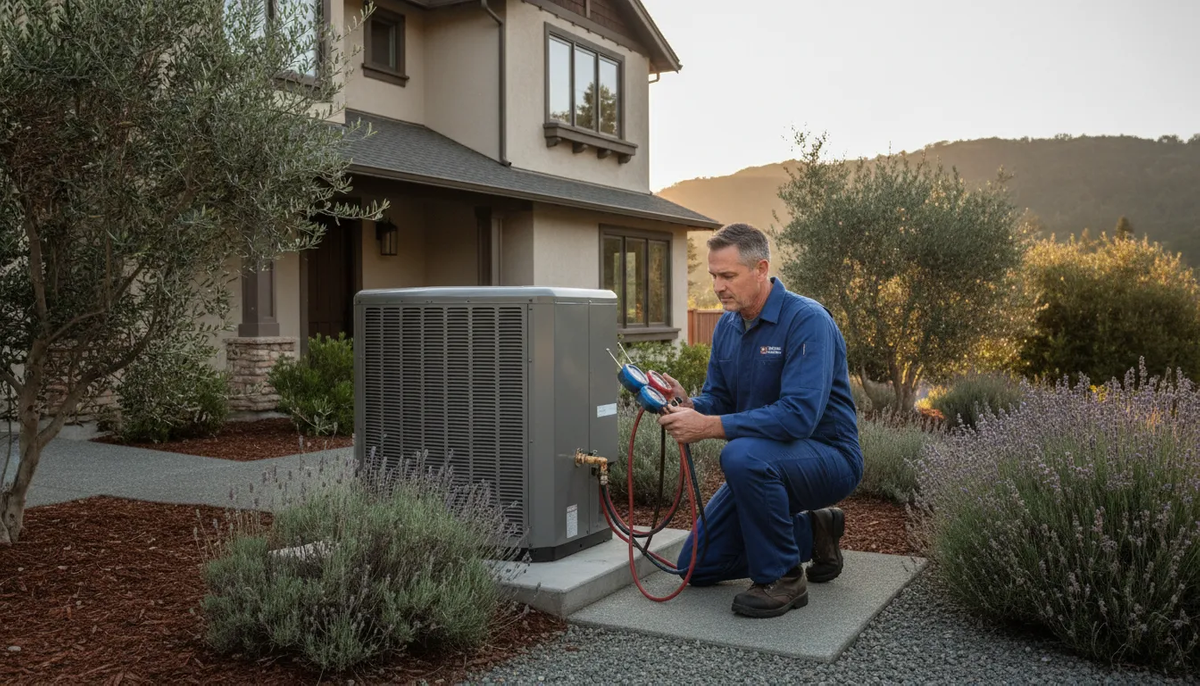
Replacing an aging furnace or adding reliable cooling is a significant home decision, especially in Redwood City's mix of established houses, townhomes, and updated properties. A heat pump can provide both heating and cooling, but the right result depends less on the equipment label than on how well the system fits the home.
Heat pump installation redwood city homeowners can rely on starts with a property assessment, accurate sizing, and a clear plan for ductwork, controls, electrical needs, permits, and commissioning. The best system may be centrally ducted, ductless, compact-ducted, or a combination, depending on the home's layout and existing equipment.
This guide explains how to evaluate climate fit, compare system configurations, understand the factors that shape project cost, and prepare useful questions for contractors. First, consider why Redwood City's Peninsula setting can work well for a properly designed heat pump. While recognizing that comfort still depends on the home's insulation, layout, and current HVAC system.
Request a free heat pump installation estimate
Is Redwood City a Good Fit for a Heat Pump?
For many Redwood City homeowners, a heat pump can be a practical option to evaluate when replacing an aging heating and cooling system. The local case is not based on a single promise about every home. It depends on how the equipment is selected, how the home is served. And what the homeowner values most: dependable comfort, efficient operation, long equipment life, and professional installation.
A Redwood City community publication has reported that heat pumps can be up to four times more efficient than gas furnaces. That figure is a general comparison, not a guaranteed result for every property. Actual performance depends on the selected system, sizing, installation quality, controls, and the home's existing conditions. It is still useful as a reason to examine the technology rather than dismissing it as unsuitable for the Peninsula. Read the local discussion of heat pumps and gas furnaces for additional context.
Why the Peninsula setting can matter
Electricity sourcing is another part of the conversation. The same publication reports that Peninsula Clean Energy offers a renewable electricity option in San Mateo County. Where that option applies and a homeowner selects it, a heat pump can provide heating and cooling without directly burning fossil fuels in the home. Availability, enrollment, and current program details should be confirmed before they influence a purchase decision.
That local context makes heat pump installation in Redwood City worth a property-specific review. It does not mean every home needs the same equipment or that a gas system should be removed without planning. A home may have different comfort needs from another home nearby, and the existing ductwork, layout, insulation, and electrical setup can affect the recommendation. The right question is whether a properly selected system can serve the home reliably, not whether one technology is universally better.
What to evaluate before choosing
How consistently the current system heats and cools the rooms your household uses most.
Whether the proposed equipment fits the home's existing configuration and comfort goals.
Whether the installation plan addresses the practical details that support dependable operation.
How the system aligns with your priorities for efficiency, longevity, communication, and professional workmanship.
For homeowners comparing options, a careful assessment is more valuable than a generic savings estimate. Ortiz approaches these decisions around the homeowner's comfort priorities and the property's needs, helping Peninsula households understand the tradeoffs before committing to equipment.
Which Heat Pump System Fits Your Redwood City Home?
The right configuration depends on how your home is laid out, whether existing ductwork is usable. And whether you are replacing all heating and cooling or improving one area. Air-source heat pumps can be installed as centrally ducted, compact-ducted, ductless, or single- and multi-zone systems. The best choice is the one that delivers consistent comfort without forcing the home into an unsuitable design.
Heat pump configurations to compare for a Redwood City homeConfigurationFitsQuestionsDuctedHomes with usable central ductworkAre the ducts sized, sealed, insulated, and balanced for the equipment?Compact-ductedHomes where full-size ducts are impracticalIs there room for the air handler and duct paths?Ductless single-zoneAn addition, home office, bedroom, or other isolated area without convenient ductworkWill one indoor unit cover the room evenly, and is its location acceptable for comfort and appearance?Multi-zoneHomes with different comfort needs across several rooms or levelsWhich spaces need separate control, and can the outdoor unit and refrigerant lines be installed appropriately?SupplementalA home retaining existing heating equipment while adding heat pump capacityWhich system operates when, and how will controls coordinate the two sources?
Match the system to the home, not just the equipment label
A ducted system may provide the most familiar whole-home experience, but only when the existing distribution system is in suitable condition. Ductless or compact-ducted equipment can reduce the need to reuse difficult duct runs. A multi-zone design can address different floors, bedrooms, or living areas, although each zone requires deliberate placement and control planning. In some projects, a mixed design makes sense, such as ducted coverage in one part of the home and ductless units elsewhere.
A supplemental approach needs especially careful sizing and controls. When existing heating equipment remains in place, conventional sizing assumptions may not apply. The U.S. Department of Energy sizing guidance identifies system selection, application, and controls as important factors in performance.
Before choosing, have the installer assess property size, insulation, layout, and ductwork, then explain why the proposed configuration fits those conditions. Ortiz has experience with heat pumps, multi-zone systems, duct redesign, challenging spaces, and multiple equipment brands. Which can be useful when a Redwood City home does not fit a standard template.
How Much Does Heat Pump Installation Cost?
There is no single heat pump installation price that applies to every Redwood City home. The project scope matters more than the equipment label alone. A proper evaluation considers the home's size, insulation, layout, existing ductwork, electrical setup, controls, and the way the system will be used. Poor sizing or system selection can affect comfort, performance, and energy efficiency, so the lowest initial bid may not represent the best long-term value.
What factors shape the project scope?
System size and configuration: A single-zone system, a multi-zone design, and a full heating and cooling replacement each require different equipment and installation planning.
Ductwork condition: Existing ducts may be suitable, need modification, or require replacement. Duct access and layout can affect labor and the final design.
Home characteristics: Property size, insulation, window exposure, room arrangement, and comfort concerns all influence the load assessment and equipment recommendation.
Electrical and control work: The installation may include electrical updates, thermostat integration, zoning controls, or other changes needed for reliable operation.
Commissioning and education: Testing the completed system, confirming controls, and showing the homeowner how to operate and maintain it are important parts of a quality installation.
Existing heating equipment can also change the design. If a homeowner keeps the current system as supplemental heat, conventional sizing assumptions may not apply, and the controls need to coordinate both systems. That decision should be made during the assessment, not after equipment has been selected.
Ortiz evaluates heating and cooling needs before recommending equipment, with attention to property size, insulation, and layout. For homeowners comparing heat pump installation in Redwood City. The most useful estimate is one that explains what is included: equipment, ductwork changes, controls, testing, commissioning, and homeowner instruction. This makes it easier to compare proposals based on complete scope and expected quality rather than a single headline number.
Ortiz offers free estimates for equipment installation, replacement, or adding new equipment. That policy does not apply to repair diagnostics or inspections. Repair visits carry applicable service-call or diagnostic fees, and a repair quote is provided after the problem has been identified.
What Should You Plan Before Installation?
A successful heat pump project starts before equipment arrives. Use the planning conversation to clarify how the system should serve your Redwood City home. What conditions may affect the work, and what you should expect from the finished installation.
Begin with an assessment of the home. Ask the contractor to review the property's size, insulation, layout, existing equipment, and comfort concerns before recommending a system. Sizing and system selection affect comfort, performance, and energy efficiency, so the equipment label alone should not drive the decision. The assessment should also identify whether the project is a full replacement, a heating or cooling upgrade, an isolated zone, or a supplemental installation.
Discuss system design, ductwork, and controls. Confirm whether a centrally ducted, compact-ducted, ductless, or mixed configuration is the best fit for the home's layout. If existing ducts are staying, ask how their condition and capacity will be evaluated. Clarify any planned duct modifications, insulation work, smart thermostat integration, zoning, or controls. If older heating equipment will remain as supplemental equipment, ask how the controls will coordinate both systems instead of assuming conventional sizing rules apply.
Request a written scope of work. The proposal should describe the equipment, locations, ductwork changes, electrical or control considerations, startup and testing, cleanup, warranty registration, and homeowner education. It should also identify what is included and what would require a separate decision. A detailed scope makes it easier to compare proposals based on quality and completeness rather than only the equipment name or initial price.
Surface older-home access and safety constraints early. Limited attic or joist space, a small access opening, possible asbestos-containing materials, and potential structural modifications can change the plan. Ask how the contractor will handle access, protect the home, coordinate any specialized work, and keep the site clean. These questions are especially important when combining an attic air handler with ductless equipment in other areas.
Set a realistic schedule. Ortiz describes standard residential installation as generally taking one to two days, but that is a planning estimate, not a guarantee. Confirm the expected start date, daily access needs, equipment delivery timing, utility interruptions, and how unexpected conditions will be communicated. Complex ductwork, electrical work, access limitations, or older-home discoveries may affect the schedule.
Plan the handoff before the crew leaves. Ask for commissioning and testing, an explanation of thermostat and control settings, warranty-registration details, equipment records, and recommended maintenance. A proper handoff gives you the information needed to operate the system confidently and confirms that the installation was tested, not simply connected. Ortiz describes installation as including commissioning, testing, and customer education, not just equipment placement. Review Ortiz HVAC installation options for the types of planning and completion services to discuss.
Do You Need Permits for Heat Pump Installation in Redwood City?
Permit and inspection requirements can depend on the equipment, electrical work, property conditions, and the scope of the project. That means a responsible heat pump installation plan should not promise that a permit is always required or assume that one is never needed. Redwood City homeowners should ask the contractor to confirm the current city and California requirements for the specific installation before work begins.
Who handles permits and code compliance?
Ask for a clear answer about whether the contractor prepares, submits, and closes any required permits, or whether the homeowner must take part in the process. The proposal should identify who is responsible for coordinating with the relevant authority and how code compliance will be documented. California code considerations may affect equipment placement, electrical connections, refrigerant work, drainage, clearances, controls, and other parts of the installation. A contractor familiar with Bay Area microclimates, California codes, and energy-efficiency requirements can explain which items apply to your home. But the requirements still need to be checked for the actual project.
What should you ask about inspections?
Will the project require an inspection, and at what stage will it occur?
Who schedules the inspection and responds if an inspector requests a correction?
Will I receive permit numbers, final approvals, or other closeout documentation?
Are electrical-panel changes, duct modifications, attic work, or structural changes included in the scope?
These questions matter because a heat pump replacement may be straightforward in one home but more involved in another. Older Redwood City homes can present limited attic access, unusual framing, aging ductwork, or other conditions that change the work plan. If the project includes a new access opening, structural modifications, asbestos concerns, or work beyond the HVAC system. Ask which trades and approvals are involved rather than treating everything as a routine equipment swap.
Get the documentation in writing
Before signing, request a written scope that separates equipment, electrical work, ductwork, controls, permits, inspections, cleanup, commissioning, and homeowner education. Also ask how warranty registration and final project records will be handled. Ortiz's installation guidance specifically recommends discussing permits and code compliance, along with sizing, controls, commissioning, warranty registration, and post-installation education. Clear documentation helps you compare proposals and know what remains outstanding after the equipment is running.
How Do You Choose a Heat Pump Installer in Redwood City?
The right contractor should do more than match a model number to your square footage. A careful heat pump installation Redwood City plan starts with how your home is built, how it is used, and what it will take to deliver steady comfort through the Peninsula's changing conditions. Ask each installer to explain the reasoning behind the recommendation, not just the equipment brand.
Ask how the system will be sized
Request a load calculation and ask what information supports the proposed capacity. The evaluation should consider the property's size, insulation, layout, windows, and existing heating and cooling needs. Poor sizing can affect comfort, performance, and efficiency, so a contractor who selects equipment from square footage alone is leaving out important parts of the decision. Ask whether the design is for a full HVAC replacement, a heating and cooling replacement, an isolated zone, or a supplemental system.
If existing heating equipment will remain, controls become especially important. The installer should explain when each system operates, how the thermostat will manage the equipment, and what happens during different outdoor conditions. This is particularly relevant when an older Redwood City home needs a combination of existing ductwork, new equipment, or more than one zone.
Look for a complete scope of work
A useful proposal should address more than the outdoor unit and indoor air handler. Ask whether the contractor will inspect insulation and ductwork, identify any layout limitations, review electrical and thermostat needs, handle required permit and code questions, and describe startup testing. Confirm what is included for removing old equipment, protecting the home, daily cleanup, and final cleanup.
Older homes may bring additional planning issues, including tight attic access, limited joist space, asbestos concerns, or possible structural modifications. These conditions should be identified before installation begins, with clear boundaries around which work the HVAC contractor performs and which work requires a qualified specialist. A Redwood City homeowner has specifically raised concerns about attic access, abatement, structural work. And meticulous daily cleanup in a complex project, which are practical questions worth asking early.
Verify qualifications and post-installation support
Check the contractor's license, bonding, insurance, relevant experience, and warranty process. Ortiz is a California licensed contractor, bonded and insured, with license CL803346. The company also reports more than 25 years of local experience, an in-house team, and Carrier Authorized Dealer status. Redwood City is within its San Mateo County and Peninsula service area, and its work includes heat pumps, multi-zone systems, duct redesign, and challenging spaces.
Before signing, ask who registers the equipment warranty, how commissioning and testing are documented, and what education you will receive on controls, filters, and normal operation. For more background, review this guide to choosing a heat pump installer, then compare the project-specific details with Ortiz's HVAC installation options. A strong installer leaves you with a system that is properly sized, tested, explained, and supported after the crew leaves.
What Happens After a Heat Pump Is Installed?
The installation is not complete when the equipment is switched on. A careful contractor should verify that the system operates as designed, explain the controls, and leave you with the records needed for future service.
Commissioning confirms the work
Commissioning includes testing the equipment, checking system operation, and confirming that the controls communicate properly with the indoor and outdoor components. The process should also account for ductwork changes, airflow, thermostat settings, and any zoning or supplemental heating controls included in the design. Quality-installation guidance from ENERGY STAR uses a checklist-based process to verify installation details rather than relying only on whether the system turns on.
Ask for a clear explanation of what was tested and whether any follow-up work remains. If the project included a smart thermostat, multi-zone controls, or a revised duct layout, those details deserve specific attention during the final walkthrough.
Keep your records and learn the controls
Save the equipment model and serial numbers, installation documentation, warranty information, and any permit or inspection records provided for the project. Ask whether warranty registration has been completed and what documentation you should retain. These records make future questions easier to answer and help a service professional understand the system without starting from scratch.
Homeowner education should cover thermostat modes, fan settings, filter access, zoning, and what normal operation sounds and feels like. You should also know whom to contact if the system displays an alert or does not maintain the expected comfort level. Ortiz includes commissioning, testing, smart thermostat integration, and customer education among its installation services.
Plan for routine maintenance
Maintenance helps protect performance as the system operates through changing seasons. Follow the contractor's recommendations for filter checks, outdoor-unit clearance, and professional service. A maintenance plan should reflect the equipment, home, indoor air quality needs, and usage patterns. It should not promise a fixed system lifespan. Instead, regular attention gives you an opportunity to identify airflow, drainage, electrical, or control concerns before they become larger problems.
For a Redwood City homeowner, the best outcome is a heat pump that is tested, documented, and understood from the first day of operation.
Request a free heat pump installation estimate
Frequently Asked Questions
What factors affect the cost of heat pump installation in Redwood City?
Cost depends on the home's heating and cooling needs, equipment capacity, ductwork condition, electrical requirements, controls, access, and whether the project includes duct modifications or other upgrades. A proper assessment of the home's size, insulation, and layout is more useful than comparing equipment labels alone. Ask for an itemized installation estimate that explains each major cost.
Should I choose a ducted or ductless heat pump?
The right choice depends on your existing ductwork, room layout, comfort goals, and zoning needs. A ducted system can serve connected living areas through existing or redesigned ducts, while ductless or multi-zone equipment can provide more targeted control where ducts are limited. Some homes benefit from a mixed approach, so ask the installer to compare practical configurations for your floor plan.
Do I need a permit for heat pump installation in Redwood City?
Do not assume that a permit is either required or unnecessary. Requirements can vary with the equipment, electrical work, property, and scope of the project. Before work begins, ask the contractor how current Redwood City and California requirements will be checked, who will handle permits and inspections, and what documentation you will receive.
Can a heat pump be installed in an older Redwood City home?
Yes, but older homes may require more planning. Limited attic or crawlspace access, constrained framing, aging ductwork, insulation gaps, electrical limitations, or possible hazardous materials can affect the design and sequence. Ask the contractor to identify these conditions before finalizing the system, and coordinate any structural or hazardous-material work with appropriately qualified professionals.
Are rebates or tax credits available for my heat pump project?
Programs and eligibility can change, and qualification may depend on the equipment, household, utility, and project details. Ask the contractor which current state, utility, or federal programs may apply, then verify requirements with the administering agency before relying on an incentive in your budget.
Ready to Plan Your Heat Pump Installation?
A well-planned installation can help you choose equipment and system details that fit your Redwood City home, comfort goals, and existing setup. For guidance on equipment replacement or a new heat pump installation, request a free estimate from the Ortiz Heating and Air Conditioning team. Share your home's current system, comfort concerns, and project priorities so the next steps can be explained clearly.