
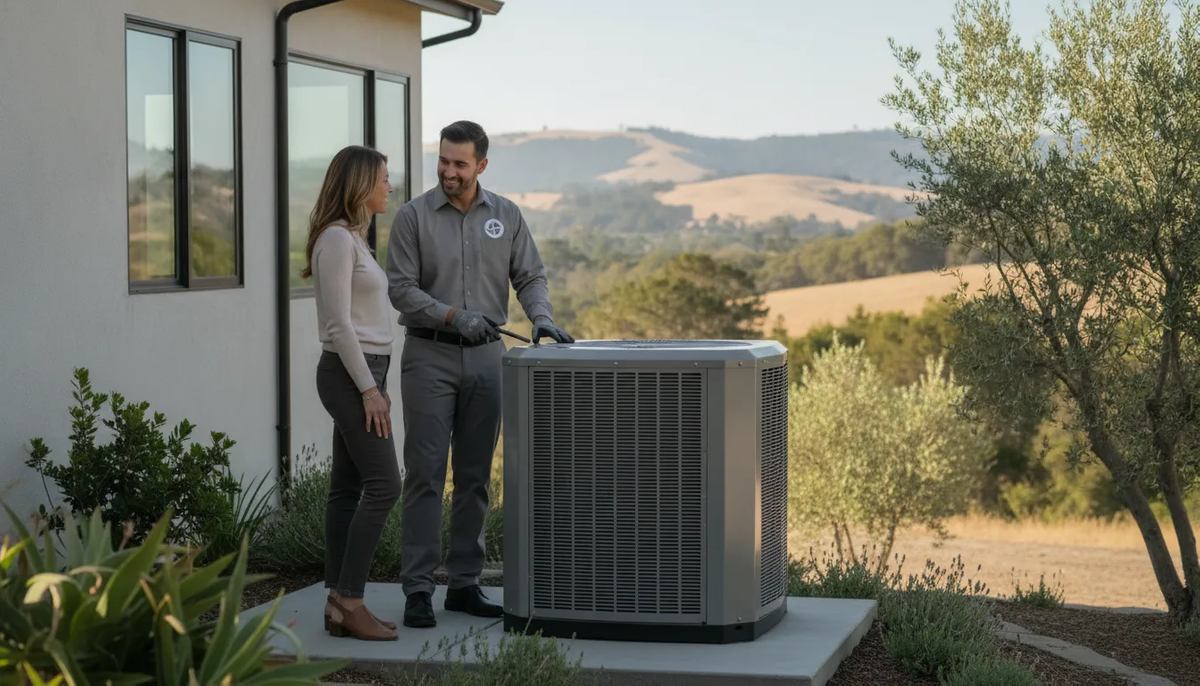
A heat pump can deliver both heating and cooling, but the equipment itself is only part of the outcome. The quality of the load calculation, system design, installation, and final startup determines whether the system fits your home and operates as intended.
The best professional heat pump installers bay area homeowners can hire prove their process, not just the equipment brand. They should explain how they will calculate heating and cooling loads and size the system. They should also explain how they will handle permits, protect the home, document warranty terms, and commission the equipment before they leave.
ACCA Manual J is the recognized method for producing residential HVAC sizing loads, according to the U.S. Department of Energy's Building America Solution Center.
That gives you a practical standard for comparing contractors. Instead of choosing the first quote or focusing on a familiar manufacturer name, look for clear answers about credentials, local experience, scope, and communication. Those details reveal whether an installer is prepared to manage the project from assessment through follow-up.
What Should You Look For in Professional Heat Pump Installers Bay Area Homeowners Can Trust?
A dependable installer should be able to explain the work clearly before asking you to approve it. Start by requesting evidence of licensing, insurance, and relevant HVAC certifications. A professional contractor should also be willing to identify who will perform the installation, what work is included, and how the completed system will be checked. These details help distinguish qualified heat pump professionals from a general handyman who may not have the training or experience required for HVAC equipment.
Verify credentials and installation responsibility
Ask the contractor to provide current licensing and proof of insurance, then confirm that the credentials apply to the company and the type of work being proposed. Certification or authorized-dealer status can provide additional context about training and equipment familiarity. It should not replace your questions about the project itself, but it can help you evaluate whether the installer understands manufacturer requirements and warranty-related responsibilities.
Also ask who is responsible for permits, equipment setup, electrical coordination, ductwork changes, and final testing. A clear answer is more useful than a general promise that the job will be handled professionally. The written scope should match the conversation, including any work that is excluded.
Look for relevant Bay Area experience
Local experience matters because the home, existing HVAC system, and project conditions all affect installation decisions. Ask whether the company has worked on homes similar to yours and whether the team evaluates the current system before recommending equipment. A thoughtful installer should be prepared to discuss ductwork, electrical requirements, comfort concerns, and the practical scope of replacing or adding a heat pump.
Ortiz Heating and Air Conditioning, Inc. is locally owned and has 25 years of experience serving homeowners and businesses across the San Francisco Bay Area. The company is Diamond Certified, BBB accredited, and a Carrier Authorized Dealer. Those distinctions are useful starting points for evaluating the company, while the installation plan and communication should still determine whether the project is a good fit.
Judge communication as part of the workmanship
Pay attention to how the installer handles questions. You should receive understandable explanations, a written scope, realistic scheduling information, and clear details about what happens after installation. If the proposal is vague or the contractor avoids discussing sizing, permits, or follow-up, ask for clarification before proceeding. For a closer look at the available heat pump installation services, review the project scope with the contractor and confirm that it addresses your home's specific needs.
How Load Calculations and Equipment Sizing Protect Comfort
A heat pump should be sized for the home it serves, not selected from a rule of thumb or matched only to the old system. A professional installer begins with a load calculation that considers the home's actual heating and cooling needs. ACCA Manual J is the industry-standard methodology for calculating residential HVAC loads for single-family detached homes. The PNNL Building America Solution Center explains ACCA Manual J and its role in equipment sizing.
This matters because an oversized system is not automatically a safer choice. It may reach the thermostat setting quickly and cycle more often, which can make temperature control less consistent and limit the system's ability to manage indoor comfort. An undersized system may struggle to meet the home's heating or cooling demand during challenging conditions. Both conditions can affect performance and comfort. Professional equipment sizing should therefore be based on accurate load calculations rather than a simple comparison with the existing unit.
What the installer should evaluate
A useful sizing review looks beyond the equipment label. The installer should evaluate the home's envelope, including insulation, windows, doors, and air leakage. These details influence how quickly the home gains or loses heat. Existing ductwork also deserves attention. Its condition, layout, and capacity can affect how effectively conditioned air reaches each room. If the ducts are restricted, leaking, or poorly matched to the proposed system, installing a larger heat pump will not solve the underlying distribution problem.
The assessment should also account for the existing HVAC system and the home's comfort patterns. Room-to-room temperature differences, additions, remodeling, and changes in occupancy can all make an old system size a poor reference point. A professional can use that information to determine whether the current infrastructure can support the proposed heat pump and whether envelope or duct improvements should be part of the plan.
Questions to ask before approving the design
Will you provide an ACCA Manual J load calculation for this home?
Which envelope conditions, windows, and insulation assumptions were used?
Did you inspect the existing ducts, and will the proposal address any restrictions or leaks?
How does the selected equipment match the calculated heating and cooling loads?
What changes would you recommend if certain rooms currently feel too warm or too cold?
Clear answers show that the installer is designing a system for the property rather than simply replacing equipment. That process is one of the practical differences homeowners should look for when comparing professional heat pump installers in the Bay Area.
Which Heat Pump System Fits Your Home?
Heat pumps can provide both heating and cooling, but the best configuration depends on how your home is built and how each room is used. A site-specific evaluation should look at the existing HVAC system, ductwork, electrical service, insulation, comfort concerns, and future plans before equipment is selected. The goal is not simply to replace one box with another. It is to create a system that distributes conditioned air effectively and operates within the home's actual requirements.
Ducted or ductless?
A ducted heat pump may be a practical choice when the home already has serviceable ductwork and a central air-distribution layout. The installer should inspect the ducts for condition, capacity, leakage, and layout before assuming they can be reused. Damaged or poorly configured ducts can limit comfort even when the outdoor and indoor units are properly matched.
Ductless mini-splits can be highly effective in homes without existing ductwork. They can also help address additions, converted spaces, or rooms that need more individual control. ENERGY STAR provides additional guidance on ductless heating and cooling systems. Ductless is not automatically the right answer, however. Indoor-unit placement, line-set routing, outdoor-unit location, and the number of zones all affect the result.
Key factors when comparing heat pump configurations.
Existing central ducts are accessible and in good condition. Ducted heat pump. Questions: Were the ducts inspected, and will airflow be verified after installation?
No ducts, or a need for room-by-room control. Ductless mini-split or multi-zone system. Questions: Where will indoor units, line sets, and the outdoor unit be placed?
Older HVAC equipment or planned remodeling. A configuration coordinated with the home's future layout. Questions: What existing components can be reused, and what should be upgraded?
Check the home's infrastructure before choosing equipment
Heat pump installation includes an electrical requirements check and system configuration, not just equipment delivery. The contractor should confirm that the electrical service, disconnect, wiring, and available space can support the proposed system. That does not necessarily mean a major electrical upgrade is needed, but it does mean the question should be answered before the work begins.
The evaluation should also consider the current heating and cooling system, envelope conditions, comfort complaints, and energy goals. A Bay Area home may have different needs from another property only a few neighborhoods away. That is why professional heat pump installers in the Bay Area should explain how the home's existing conditions shaped the recommendation, rather than presenting a one-size-fits-all package.
What Permits and Installation Details Should Be Included?
A sound installation plan covers more than the heat pump model. It should explain who handles local approvals, how the work will meet applicable codes. And what the installer will do to protect your home and document the finished system. Requirements can vary by city and project, so treat permit coordination as a question to resolve before work begins, not an assumption. Ask the contractor to confirm the process with your local building department.
Confirm permit responsibility before scheduling. Ask whether the contractor will identify required permits, prepare the application, coordinate inspections, and provide copies of the final records. A permit may be required for a particular project, but homeowners should confirm the applicable requirements with their local building department. The answer can depend on the municipality, the equipment, and related electrical or structural work.
Verify code and manufacturer requirements. The installation plan should account for local building and electrical standards as well as the equipment manufacturer's instructions. Those instructions can affect clearances, line-set routing, condensate management, electrical connections, mounting, and startup procedures. Following both sets of requirements supports safe operation and helps protect applicable warranty terms. The Building America Solution Center notes that heat pump installation and use should follow local regulations and manufacturer instructions: review the installation guidance with your contractor.
Ask how the workmanship will be checked. A professional should be able to describe the installation sequence and the checks behind it. Discuss the condition of existing ductwork, equipment connections, electrical capacity, drainage, outdoor-unit placement, and the way the system will be configured for the home. Heat pump work benefits from professional oversight because several parts of the existing HVAC system may affect the final result.
Make jobsite protection part of the plan. Ask how floors, walls, landscaping, and furnishings will be protected while equipment and materials move through the property. Confirm where the crew will place removed equipment, how debris will be handled. And whether the work area will be cleaned at the end of each day and at completion. These details do not replace technical quality, but they reveal whether the contractor has planned the project carefully.
Request complete documentation at handoff. Keep the permit and inspection records, equipment model and serial information, warranty materials, installation notes, and any operating instructions. Ask the installer to explain basic controls and recommended maintenance, and to identify any follow-up work or homeowner responsibilities. Clear documentation makes future service easier and gives you a useful record of what was installed and how it was set up.
Before approving the work, make sure these responsibilities appear in writing. A detailed scope helps you compare installers on process and accountability, not just on the equipment name printed on a proposal.
How to Compare Heat Pump Installation Quotes Fairly
The lowest-looking quote is not necessarily the clearest or most complete. Compare the scope behind each proposal so you can tell whether contractors are recommending the same type of work. A professional heat pump installation quote should identify the equipment, labor, permit fees, and warranty provisions rather than combine every item into one unexplained total. Review the HVAC installation process and use it as a framework for questions about what each proposal includes.
Check the equipment line by line
Ask for the manufacturer, model number, system type, and included components. Two heat pumps may look similar on a proposal while differing in capacity, configuration, controls, or indoor equipment. The model information also gives you a way to confirm that the proposed system matches the home's assessed heating and cooling needs. Do not compare quotes by brand name alone.
Separate included work from exclusions
Read the labor and installation scope carefully. A complete comparison should make clear whether the contractor has included removal of existing equipment, equipment placement, refrigerant lines, condensate management, startup, and cleanup. It should also state what happens if the existing ductwork needs modification or if electrical work is required. Existing ductwork and installation complexity can influence the work involved, so an allowance or vague phrase such as "as needed" deserves a specific follow-up question.
Equipment: Confirm model numbers, capacity, included indoor and outdoor components, and controls.
Labor: Identify removal, installation, commissioning, cleanup, and any assumed site conditions.
Permits and electrical: Ask who handles permits and whether panel, disconnect, wiring, or other electrical work is included.
Duct scope: Confirm whether existing ducts are inspected, sealed, modified, or excluded.
Warranty: Record equipment and labor coverage, registration responsibility, and any conditions tied to professional installation.
Schedule: Ask when work can begin, how long it should take, and how changes will be documented.
Make the final comparison apples to apples
Before choosing, ask each installer to revise unclear allowances and list exclusions in writing. Compare the same scope, not just the headline number. A transparent proposal should help you understand what you are buying, what remains your responsibility, and which assumptions could change the work. That clarity is often more valuable than a quote that appears lower but leaves essential parts of the installation undefined.
Why Commissioning and Follow-Up Matter After Installation
Installation is not finished when the equipment is mounted and the work area is cleaned. Commissioning is the final verification that the heat pump has been installed correctly, configured properly, and is operating as intended. It gives the installer an opportunity to confirm that the completed system matches the design and the manufacturer's requirements. This is better than assuming that a powered-on unit is ready for everyday use.
Commissioning should address the system as a whole. At a high level, the installer may verify operating settings, airflow, refrigerant-related performance, electrical connections, controls, and the interaction between the indoor and outdoor equipment. The exact checks depend on the system and installation. A responsible contractor should be able to explain what was tested without presenting a generic checklist as a substitute for job-specific verification.
Following manufacturer instructions and applicable local requirements matters for both performance and warranty administration. The Building America Solution Center notes that heat pump installation and use should follow local regulations and manufacturer instructions. Ask for confirmation that the installation was completed according to those requirements, along with any commissioning records or startup documentation the contractor provides.
A useful homeowner orientation prevents avoidable confusion
A professional handoff should leave the homeowner comfortable using the system. The installer should explain the thermostat or control interface, heating and cooling modes. Filter location and replacement considerations, normal operating sounds, and what to do if the system displays an alert. This conversation is especially valuable when a heat pump replaces equipment that operated differently. Understanding the controls helps homeowners avoid changing settings based on incorrect assumptions about how the system should run.
Keep records and plan for ongoing care
Save the equipment model information, warranty documents, permit records when provided, installation paperwork, and commissioning notes in one place. These records can make future service more efficient and help establish what equipment was installed, when the work occurred, and which warranty procedures apply. Ask who handles warranty questions and what documentation is needed if a covered issue arises. Warranty terms vary by manufacturer and installation, so avoid relying on verbal assurances alone.
Follow-up also includes a maintenance plan. Regular maintenance and professional installation support the long-term performance and reliability of a heat pump system. Review the recommended service interval and have the contractor explain which homeowner tasks are appropriate between professional visits. You can learn more about ongoing heat pump maintenance before finalizing your installation decision.
Why Bay Area Homeowners Choose Ortiz for Heat Pump Installation
Choosing an installer is about more than selecting a recognizable equipment brand. Homeowners also need a contractor that can understand the property, explain the proposed work, and carry the installation through with care. Ortiz Heating and Air Conditioning. Inc. brings 25 years of experience to heat pump installations and provides personalized HVAC solutions for homeowners and businesses in the San Francisco Bay Area.
That local ownership matters because every installation starts with the home's existing conditions, not a one-size-fits-all package. The right approach considers the current heating and cooling setup, the way the home is used, and the practical details that affect comfort and system operation. Ortiz's role is to help homeowners understand those decisions so they can evaluate an installation plan with confidence.
Ortiz is also a Diamond Certified contractor and a BBB accredited business. These distinctions are useful signals for homeowners comparing professional heat pump installers because they provide additional context about the company's standards, customer service, and business practices. They do not replace questions about the specific project, but they can help distinguish an established HVAC company from a contractor whose experience is difficult to verify.
As a Carrier Authorized Dealer, Ortiz has specialized familiarity with Carrier equipment and its installation requirements. That capability supports a more complete process, from selecting an appropriate system through installation and final setup. Ortiz also provides ongoing HVAC care, so homeowners can plan for heat pump maintenance after the installation rather than treating the project as finished when the equipment starts running.
Ortiz's heat pump installation services are a fit for homeowners who want an informed evaluation, clear communication, and professional attention to the details behind long-term comfort. Once you know what to look for in an installer, the next step is to discuss your home's needs and determine whether the proposed scope matches them.
Request a heat pump installation quote from Ortiz Heating and Air Conditioning
Frequently Asked Questions
How do professional heat pump installers perform load calculations?
A qualified installer evaluates the home's heating and cooling needs rather than sizing equipment from square footage alone. Ask whether the proposal includes an ACCA Manual J residential load calculation, a recognized method for producing HVAC equipment sizing loads. The installer should also discuss insulation, windows, ductwork, and the home's existing system before recommending capacity. Learn more about ACCA Manual J.
What permits are required for heat pump installation in the Bay Area?
Permit requirements vary by the city or county and by the scope of work, but heat pump projects commonly require review by the local municipal building department. Ask the installer to identify the permits required, state who will obtain them, and confirm that inspections are included in the project plan. The final installation should follow applicable local regulations and manufacturer instructions.
Why choose a professional installer instead of a handyman?
Heat pump work combines equipment selection, refrigerant and electrical considerations, airflow, ductwork, controls, code compliance, and manufacturer requirements. A professional HVAC contractor can evaluate those connected systems, document the work, and commission the equipment after installation. Verify licensing, insurance, relevant HVAC experience, and who is responsible for each part of the job before signing.
How does equipment sizing affect heat pump performance?
An oversized or undersized system can affect comfort and efficiency. Proper sizing matches the equipment to the home's calculated heating and cooling loads, while also accounting for the existing duct system and operating conditions. Ask the installer to explain the recommended capacity, the load calculation behind it, and how the system will handle the home's heating and cooling requirements.
What should be included in a heat pump installation quote?
A useful quote identifies the equipment model, labor, permit fees, electrical or ductwork changes, startup and commissioning scope, warranty terms, schedule, and exclusions. It should make clear what is included and what could change if concealed conditions are found. Comparing these line items helps you evaluate competing proposals fairly instead of choosing based only on a single total.
Ready to Request a Heat Pump Installation Quote?
A thoughtful installation starts with understanding your home's comfort needs, equipment options, and project scope. Ortiz Heating and Air Conditioning can help you move from research to a clear next step.
Request a heat pump installation quote from Ortiz Heating and Air Conditioning