
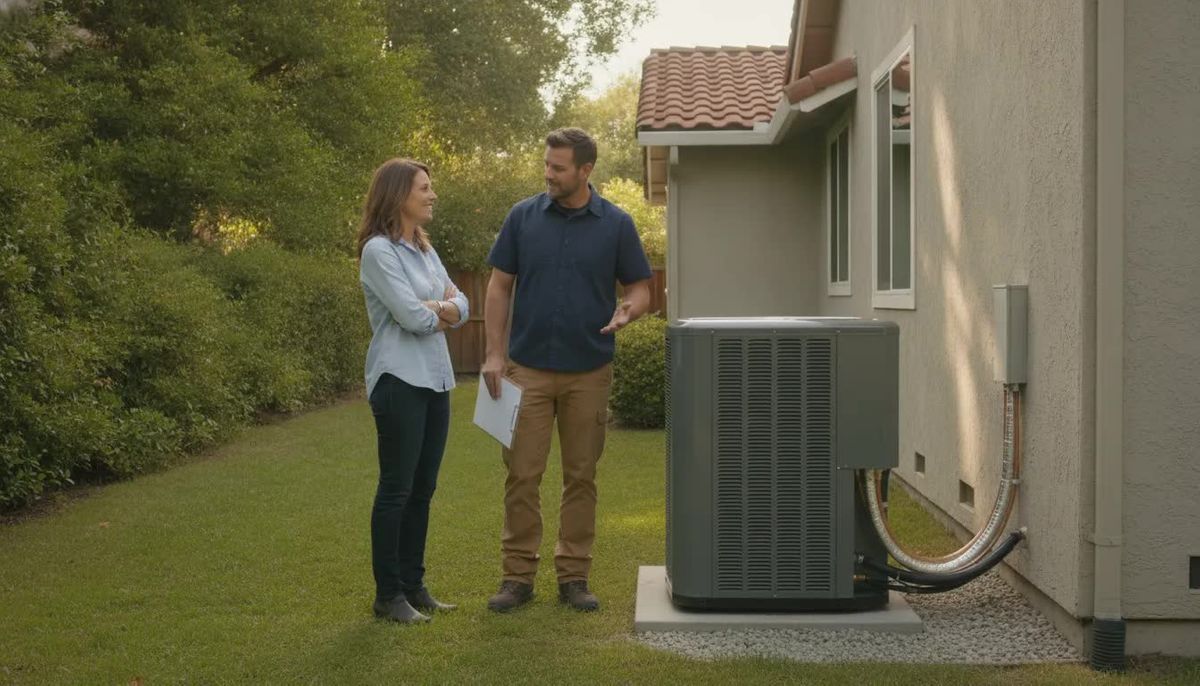
An HVAC permit is a local approval for specified heating or cooling work, and the rule is not the same in every Bay Area city. A like-for-like furnace swap, a new condenser, and a full heat pump conversion can each trigger a different submittal. The building department for your address decides, not a statewide checklist. Ask before equipment is ordered, and put in writing who will pull the permit and meet the inspector.
Request a quote for a permitted HVAC replacement
What an HVAC permit actually covers
A permit is the city's way of reviewing proposed work and scheduling an inspection. For HVAC, that review can touch the mechanical equipment, the electrical circuit that feeds it, gas piping, condensate drainage, and any opening cut into a wall or roof. The paper record also shows a later buyer, insurer, or appraiser that the change was inspected.
California's Contractors State License Board tells homeowners that permit needs vary by city, county, and town, and that the local building department is the source for a specific project. That is why a neighbor's experience in the next city is a poor guide. Daly City, San Mateo, Menlo Park, Oakland, and Piedmont each run their own counter, forms, and amendments.
Two jobs that look similar on a proposal can land in different categories. Replacing a furnace in the same closet is often a lighter submittal than moving that furnace to the attic or adding cooling where none existed. Adding a heat pump in place of a gas furnace can also pull in an electrical review, because the new equipment draws more power than the furnace it replaces.
The permit is not a design service. It does not choose the tonnage, the duct size, or the brand. Those decisions still belong in a load calculation and a written scope. The permit checks that the chosen work, as drawn and specified, meets the code in force on the day you apply.
When Bay Area homeowners should ask
Ask before any of these are on the schedule:
Replacing a furnace, air handler, condenser, or heat pump, even in the same location.
Adding air conditioning to a house that has never had it.
Moving equipment, including a new pad, a wall mount, or an attic install.
Changing fuel, such as leaving gas heat for an electric heat pump.
Replacing most of the duct system along with the equipment.
Cutting a new flue, chase, or structural opening.
A clogged filter, a failed capacitor, or a refrigerant top-off is ordinary service, not a construction project. Still, do not guess that a repair is exempt. If the technician has to replace a major component or relocate equipment to finish the repair, pause and ask the building department before the work grows.
Timing matters because some cities will not issue the permit until product sheets and energy forms are in the file. If the equipment has already been ordered, a reviewer can still ask for a different form, a site plan, or a structural note. That is an expensive moment to discover the submittal was thin. Build the permit step into the proposal, not the last week before install day.
Homeowners in the Daly City and Peninsula area, the San Francisco Bay Area, and the East Bay in Alameda County should use the department that serves the property, not a county-wide shortcut. Unincorporated pockets and city limits do not always match mailing addresses.
How local rules differ, with two real examples
Menlo Park publishes a plain submittal guide for furnace and air conditioner replacement in a single-family home. The city accepts applications only online, through its Accela portal. A new furnace in the existing location does not need a plan set. The file still needs a building permit application, product specifications, and a signed Title 24 form, CEC-CF1R-ALT-05-E. Move that furnace outside or into the attic, and the city adds a lot plan, a floor plan, and structural calculations for an attic move.
Cooling is stricter in that city. Menlo Park has adopted a local amendment to the 2025 California Green Building Standards Code. When the project replaces or upgrades an existing air conditioning condenser, the city requires a heat pump instead of another straight air conditioner. The cooling submittal uses a different energy form, CEC-CF1R-ALT-02-E, plus a lot plan that shows equipment, property lines, the electric panel, and the required receptacle. Read the city's current sheet before you assume a like-for-like condenser is allowed. Rules change, and this one is local, not statewide.
Piedmont draws a brighter line. The city says a mechanical building permit is required for any HVAC work, including heating, venting, or air conditioning. Subtypes cover furnace, furnace and AC, heat pump, AC, and other. Furnace files call for CF1R Title 24 forms. If the project replaces a furnace and at least 75 percent of the ductwork, Piedmont also asks for a Manual J load calculation. Projects over 0,000 need a construction and demolition debris recycling statement. More than two AC or heat pump units on a site can trigger design review, with sound limits and placement rules for ground or low-wall units.
Those two cities sit a short drive apart and already disagree on tone. One spells out when plans are skipped. The other says mechanical work needs a permit and then lists extras. San Mateo, Oakland, Berkeley, and smaller towns will not match either page word for word. Use the examples as a picture of what "it depends" looks like, then open the page for your own address.
What a typical replacement file includes
Across cities, the same pieces show up again and again. You will not need every item on every job. You should expect the reviewer to ask for several of them.
A permit application that states the scope in plain language: replace, relocate, or add.
Manufacturer specification sheets for the furnace, coil, condenser, or heat pump.
A completed, signed Title 24 alteration form. In Menlo Park that is CF1R-ALT-05-E for many furnace replacements and CF1R-ALT-02-E when cooling equipment is involved.
A site or lot plan when outdoor equipment is new or moving, with distances to property lines.
A floor plan when the indoor unit changes rooms.
Structural notes if equipment is going into an attic or onto a roof.
A Manual J load calculation when the city requires it, often when ducts are largely replaced.
Electrical information when the job adds a circuit, a disconnect, or a heat pump that needs more capacity than the furnace it replaces.
Title 24, Part 6, is California's Building Energy Efficiency Standards, published by the California Energy Commission. The standards are updated on a three-year cycle. The form you sign has to match the code edition the city has adopted, not an older PDF saved on a desktop. If a contractor hands you a form from a previous cycle, ask which edition the counter is accepting this month.
Efficiency ratings are a separate question from the permit form. If you are comparing SEER2 numbers while you pick equipment, the California SEER2 requirements guide covers that choice. Bring the chosen model numbers back to the permit set. Do not let the rating conversation replace the energy forms.
Who pulls the permit, and what owner-builders take on
On a normal replacement, the contractor pulls the permit, schedules the inspection, and meets the inspector. That duty should be a line in the proposal, with the city named. "Permit by owner" or "permit excluded" means you are about to become the applicant.
California's Contractors State License Board is direct about that role. If you sign the permit as an owner-builder, you take responsibility for code compliance and inspections. You also take on supervision of the work. Hiring unlicensed workers can put you in an employer role, with payroll, insurance, and tax duties you did not plan for. Read CSLB's owner-builder responsibilities page before you sign an owner-builder declaration to save a fee.
A licensed contractor does not remove your duty to pick a real company. Ask for the license number and confirm it on the CSLB site. Ask who employs the installers who will be in the house. Ask which city the application will be filed in, and ask for the permit number before demolition or equipment removal starts. If the number does not exist yet, the job has not been cleared.
Ortiz handles permitted HVAC installation across the Peninsula and East Bay, including furnace, central air, and heat pump replacements. The scope conversation is the right time to name the city, the equipment location, and whether ducts or electrical work are part of the job. Those three facts decide how thick the submittal is.
How the permit changes the project plan
Treat the permit as a step with its own duration, not as a stamp that appears on install morning. A same-location furnace in a city with online intake can move faster than a project that needs plans, structural math, or a design-review check. Nobody honest can promise a day count that fits every counter.
Build the sequence like this:
Write the scope: equipment type, fuel, indoor location, outdoor location, duct changes, and electrical changes.
Match that scope to the city's current handout, not to a blog summary.
Collect product sheets, the correct Title 24 form, and any plan sheets before the application goes in.
File, answer review comments, and wait for issuance.
Install only after the permit number exists, then close with the required inspection.
Location drives cost and paperwork together. A condenser on a new pad needs clearances and, in some cities, a sound check. An air handler moving to the attic can need framing. A heat pump replacing a gas furnace can need a panel review. Each of those is both a construction task and a permit task. If you are weighing a gas furnace against a heat pump, settle the equipment question in the heat pump versus gas furnace guide first, then come back to the submittal that choice creates.
Rebates do not replace permits. A utility or regional incentive may want the same model numbers and the same proof of a closed permit. The Bay Area heat pump rebates guide covers incentive sources. Keep the permit file and the rebate file separate so a missing inspection does not hold up both.
Duct changes deserve their own line. Sealing a few leaks is maintenance. Replacing long runs, adding returns, or resizing trunks can change the mechanical scope and, in cities like Piedmont, can trigger a load calculation once most of the ductwork is new. If ducts are part of your project, start from the duct services scope and tell the building department exactly how much ductwork is being replaced. "Some ducts" is not a description a reviewer can approve.
Questions to settle before you sign
Use this list in the proposal meeting. The answers should land in the contract, not in a text message after the deposit.
Which city or county building department has jurisdiction over this address?
Will the contractor pull the permit, and is the fee included?
Is the job a same-location replacement, a relocation, or new equipment?
Does this city still allow a straight air conditioner replacement, or does a local rule require a heat pump?
Which Title 24 form will be signed, and who prepares it?
Are plans, structural calculations, or a Manual J required for this scope?
Will any electrical work be filed with the same permit or a separate one?
Who meets the inspector, and what happens if the inspector asks for a correction?
When will you receive the permit number and the final inspection sign-off?
If the proposal says the permit is excluded, ask what you are expected to file and whether the contractor will still appear at inspection. A low price that leaves the permit to you is not a discount if you are not set up to be an owner-builder. It is a transfer of risk.
Also separate repair from replacement. A no-cool call or a furnace that will not start belongs with HVAC repair. Replacement planning belongs with installation. Mixing the two in one sentence is how a service visit turns into unpermitted construction. If you are unsure which side of that line you are on, the repair or replace guide walks through the equipment decision. The permit decision follows the scope, not the other way around.
Commercial roofs, restaurants, and multi-family buildings follow a different path, with different reviewers and often a design professional. This article is about houses. Commercial permit scope should be confirmed on the commercial HVAC page's project, not copied from a single-family handout.
Contact Ortiz to review your city's permit scope
Frequently asked questions
Does every HVAC repair need an HVAC permit?
No. Ordinary repairs such as a capacitor, a filter, or a thermostat often do not. Replacement, relocation, new equipment, and many duct replacements do. Your building department is the authority for the address, so describe the exact scope instead of asking about "HVAC work" in general.
Can I replace a furnace in the same closet without plans?
Sometimes. Menlo Park says a new furnace in the existing location does not need a plan set, but the city still wants an application, product sheets, and a signed Title 24 form. Another city can require more. Check the handout for your city before you treat "no plans" as "no permit."
Who is responsible if I sign as an owner-builder?
You are. CSLB says an owner-builder is responsible for pulling permits, passing inspections, and code compliance. You also take on supervision of workers. That is a poor trade for a routine equipment replacement you hired a contractor to perform.
Does a heat pump change the permit compared with a new air conditioner?
It can. Menlo Park requires a heat pump instead of a replacement air conditioning condenser under a local 2025 CalGreen amendment. Heat pumps can also need a larger electrical circuit than the equipment they replace. Both points belong in the submittal, not as surprises on install day.
How long does approval take?
It depends on the city, the completeness of the file, and whether plans or structural notes are required. A same-location replacement with a complete online file moves faster than a relocation or a design-review case. Ask the counter for current review times when you apply, and do not schedule demolition around a guess.