
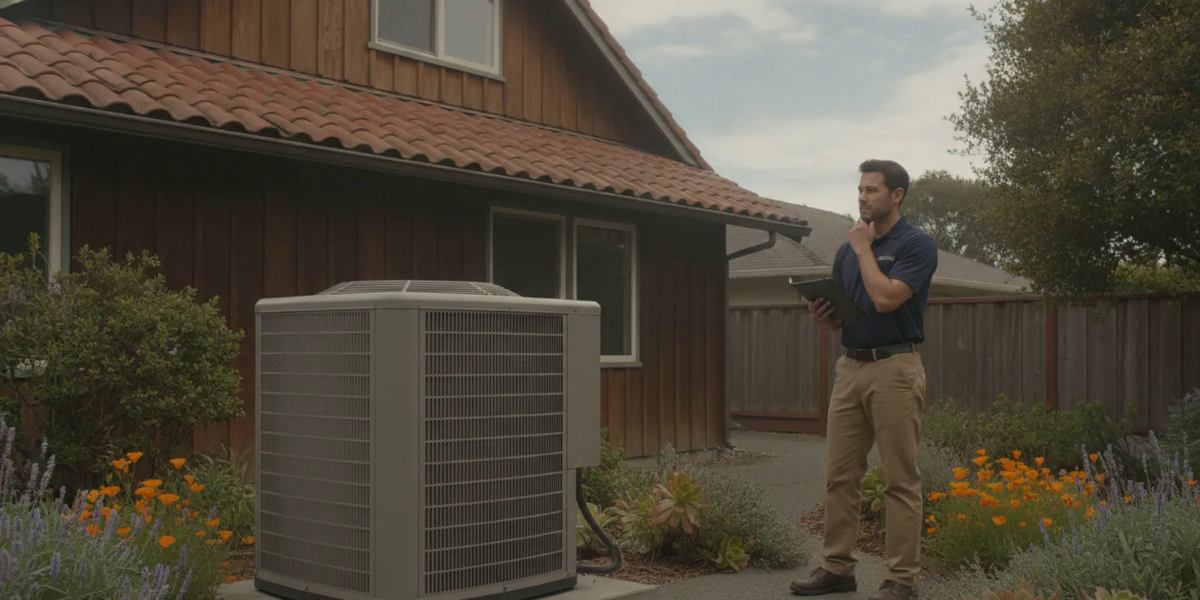
If you are searching for how to repair air conditioner compressor problems, the safest first step is not to open the outdoor unit. The compressor sits in a pressurized refrigerant circuit and works with electrical parts that can cause serious injury. You can note symptoms and check a few conditions from outside the equipment. Testing, opening the circuit, and the repair itself belong with a trained HVAC technician. Ortiz Heating and Air Conditioning, Inc. is based in Burlingame and works with homes and businesses across the San Francisco Bay Area, including the Peninsula and the East Bay. If the outdoor unit is humming, warm air is coming from the vents, or a breaker has tripped, start with the HVAC repair services page. A technician can diagnose the system instead of guessing at the compressor.
Arrange a professional HVAC assessment
What does an air conditioner compressor do?
The compressor is a central part of the outdoor section on many air conditioners and heat pumps. It moves refrigerant through the system so heat can leave the indoor coil and be released outside. It does not cool the air by itself. Fans, controls, electrical components, coils, filters, and ductwork all have to work with it.
That is why a comfort problem at the thermostat does not name the failed part. The compressor may be failing. It may not be getting the electrical signal or the operating conditions it needs. Or a different problem may be creating the same symptoms. The outdoor fan can keep spinning while the house stays warm. A sound is a clue, not proof that one part needs replacement.
Correct diagnosis matters because replacing a major component will not fix a separate control, airflow, or electrical problem. The original cause stays in place, and the household still does not have reliable cooling. A technician should look at the equipment as a system and explain which findings support the proposed work.
Which symptoms could point to compressor trouble?
Several signs can justify a service call. None of them confirms compressor failure on its own. Look at the whole pattern: when the symptom shows up, and whether the indoor and outdoor portions appear to run.
Cooling is weak or absent: The thermostat calls for cooling, but the home stays warm or takes longer than usual to feel comfortable. Airflow, controls, the outdoor unit, or other system conditions may be involved.
The outdoor unit hums or clicks: These sounds can come from different electrical or mechanical parts. Do not remove a panel to find the source.
The outdoor fan runs without effective cooling: The fan and the compressor do different jobs. Seeing one run does not prove the other is working.
The system starts and stops repeatedly: Short cycling can relate to the thermostat, airflow, equipment condition, or other controls. Note how often it happens and how long each run lasts.
A breaker trips: A trip can signal an electrical problem. If it trips again after one reset, leave it off and arrange service. Do not keep restoring power.
The outdoor unit does not start: A thermostat call, a power issue, a control, wiring, or a component fault could all stop operation. Opening the unit will not safely sort those causes.
Ice or unusual heat is visible: Ice on the equipment or lines, or an unusually hot outdoor cabinet, needs attention. It still does not tell you which part failed.
Make a simple timeline. Note whether the problem appears at every start-up, only on warmer afternoons, or after the system has run for a while. Record whether the indoor blower seems to run, whether the outdoor fan moves, whether the thermostat shows a warning, and whether one room is affected or the whole building. Those notes help a technician narrow the visit without turning a symptom check into a diagnosis.
If the outdoor fan runs and the indoor air is still warm, report both facts. Do not conclude that the compressor is the cause. If the system cools at first and then stops, note about how long it ran and whether it starts again on its own. If the breaker trips, record whether it happened once or again after a reset, and stop there. Two homes can show similar symptoms for different reasons. A careful description is more useful than a guessed part name.
Context helps too. Was there a recent power interruption? Did the concern start after a thermostat change, a filter replacement, or a service visit? Did it begin suddenly or worsen over several days? None of that diagnoses the equipment. It gives the technician a practical starting point and separates a one-time event from a pattern.
What you noticeWhat it does not proveSafe next stepOutdoor unit hums, then stopsThat the compressor itself has failedNote the sound and duration. Do not open the panel.Fan runs and indoor air stays warmWhich part stopped moving heatReport both observations. Leave testing to a technician.Breaker trips again after one resetThe exact electrical faultLeave the breaker off and arrange service.Ice on lines or the cabinetA refrigerant or compressor diagnosisTurn cooling off. Do not chip ice or open the unit.
What can you safely check before arranging service?
Keep every check outside the cabinet and limited to ordinary controls. Do not remove equipment panels, put fingers or tools through a grille, touch wires, handle refrigerant lines, or turn service valves. If a check would mean opening the equipment or reaching into a cabinet, leave it for the technician.
Confirm the thermostat is calling for cooling. The mode should be set to cooling, and the set temperature should be below the current room temperature. If the screen is blank or the controls do not respond, write that down. Do not open the furnace or air handler to investigate.
Look at the air filter. If it is visibly dirty, replace it with the correct size and type, following the filter and system instructions. A restricted filter can affect airflow. Replacing it does not prove the compressor is fine, and it does not repair a fault that still needs diagnosis.
Observe the outdoor unit from a safe distance. Note whether the unit appears to run and whether stored items or loose debris are crowding it. Do not reach through the grille or take a cover off to clear anything.
Check the breaker only if it is safe and accessible. If it is tripped, reset it once at most. If it trips again, leave it off and request service. Repeated resets are not a repair, and they can keep feeding an electrical fault.
Look for visible ice or water without touching the equipment. If you see ice, turn cooling off and contact a technician. Do not chip the ice or apply heat. Note where you see ice or water and when you first noticed it.
Write down what changed. Record the start date, sounds, room conditions, thermostat settings, and any recent power interruption or maintenance. If a model label is plainly visible without opening a panel, you can share it. Do not remove a cover to find it.
These checks can clarify operating conditions. They cannot safely test a compressor or confirm a refrigerant issue. If you want to see how a service visit is set up, review Ortiz's HVAC service call information. For how a technician's findings can guide a repair or replacement decision, see this guide to air conditioning repair. Broader cooling symptoms that are not specific to the compressor are covered in Ortiz's Bay Area AC troubleshooting guide.
How to repair air conditioner compressor problems starts with a technician
Compressor diagnosis can involve electrical testing and work on a sealed refrigerant circuit. Electrical components may carry hazardous voltage. Refrigerant needs the right tools, handling practices, and, for many systems, certification under federal rules. Opening the circuit, bypassing a control, or attempting a live test can cause injury, damage the equipment, or leave the system running incorrectly.
There is a practical reason not to guess. The same symptom can have different causes. A humming outdoor unit might not mean the compressor itself is defective. Weak cooling might be related to airflow or another system condition. Replacing a part before the cause is identified can add cost while the original problem remains.
A qualified technician can assess the system, decide whether the compressor is involved, and explain the evidence. Ortiz provides air conditioning services for cooling systems that need professional testing, and the repairs team handles problems that cannot be sorted from the thermostat. For the federal rules that limit who may handle refrigerant, the U.S. Environmental Protection Agency explains Section 608 technician certification. That page is general guidance. It is not a diagnosis of your equipment.
What may happen during a professional diagnosis?
The visit depends on the equipment, the symptom you reported, and what the technician sees. It often starts with questions: when the problem began, how often it happens, and whether anything changed recently. The technician may check the thermostat call, the visible condition of the equipment, airflow, and the operating controls before choosing tests.
When those checks point further, a technician can use suitable instruments and safe procedures to assess electrical components and system operation. A refrigerant-side evaluation may also be appropriate. The goal is to learn why the system is not doing what it should, whether the compressor is actually involved, and whether another condition contributed. The diagnosis should set the scope of repair, not the other way around.
Share facts rather than a fixed conclusion. Say, "The outdoor unit hums for a short time, then stops, and the house stays warm," instead of insisting that the compressor is broken. Tell the technician whether the indoor blower runs, when you noticed the noise, and whether the breaker tripped. If one room is warm while others cool normally, say so. Room-by-room details can separate a whole-system issue from an airflow or distribution concern.
Inspection and diagnostics have a service fee. Free estimates apply only when you are replacing or adding new equipment, not when the visit is to diagnose a repair. Once the problem is identified, a quote can be provided for the repair work. Ask what the visit includes, what the findings show, and what work is proposed before you decide. If you are not sure whether the outdoor unit is a straight air conditioner or part of a heat pump, Ortiz's heat pump services page explains that equipment type.
How to repair air conditioner compressor problems versus replacing the system
A suspected compressor issue does not automatically mean the whole system must be replaced. First establish what failed. Then look at the condition of the rest of the equipment, the work required, compatibility, and what the household needs for comfort. Compare the actual repair plan with the actual replacement scope. Do not decide from a symptom alone.
When might a focused repair make sense?
If testing finds a repairable condition and the rest of the system is in suitable shape, a focused repair may solve the problem without replacing unrelated equipment. Ask which component or condition caused the symptom, what work is included, and whether the repair opens the refrigerant circuit. Ask which operating checks will follow the work, and which signs you should watch afterward.
A useful example is a system that stops cooling after a control or electrical issue is found. The question is whether the diagnosis identifies that issue and whether the proposed work addresses it. Do not use the example to identify a fault yourself. Let the technician test the equipment and explain the findings.
When is it useful to discuss replacement?
If testing confirms the compressor has failed, ask how the equipment's age and overall condition change the options. A technician can explain whether related parts, refrigerant-circuit conditions, compatibility, or the amount of work change the recommendation. Replacement is worth discussing when a repair is extensive or the rest of the equipment also needs attention. No single symptom settles that decision for every home.
Compare the two paths in practical terms. Which components and labor are in the repair? Which equipment and installation steps are in a replacement? How will either option fix the original comfort problem? What maintenance should you plan afterward? Ortiz's HVAC installation services page explains the installation path if replacement becomes the better fit.
What should you ask before approving compressor work?
You do not need to direct the repair to ask for a clear explanation. These questions help you understand the recommendation and compare options:
What test or observation supports the diagnosis?
Could another component create the same symptom, and how was that possibility checked?
What work is included, and which parts of the system will be affected?
Does the proposed work involve electrical components or opening the refrigerant circuit?
What checks will confirm the equipment is operating after the repair?
What should I watch after the visit, and what should I do if the symptom returns?
If replacement is an option, what is different about the scope and purpose of each path?
Ask for the recommendation in writing and keep the service paperwork. If broader system work is proposed, ask which finding makes it necessary, and whether it needs attention now or can be planned. After the current fault is resolved, Ortiz also provides HVAC maintenance so you can talk about upkeep. You can read more about the company on its company information page.
Contact Ortiz to discuss your air conditioning concern
How should Bay Area homeowners prepare for the next step?
Bay Area homes do not all see the same weather. Coastal neighborhoods and inland areas put different loads on cooling equipment, and the timing of a complaint can vary by building and by room. Say whether the concern affects one room or the whole home, whether it shows up at a certain time of day, and whether anything recently changed. That context is more useful than assuming the compressor is the cause.
When you contact a service provider, keep the summary short: what the system does, when it began, what you saw indoors and outdoors, and whether a breaker tripped or ice appeared. Mention simple checks you already made, such as confirming the thermostat setting or replacing an obviously dirty filter. Do not run risky tests to make the report sound more complete.
Ortiz serves Bay Area communities from its Burlingame location, including the San Francisco Bay Area and the East Bay. Peninsula coverage is listed on the areas we serve page. If the equipment serves a business rather than a home, describe the affected rooms and the operating schedule, and start with the company's commercial HVAC services.
Weekday office hours are 7:30 a.m. to 5:30 p.m. Emergency heating is a separate urgent path, not a promise that someone is available at all hours. For a cooling complaint, use the contact page and describe the symptoms so the visit can be scheduled appropriately.
Frequently asked questions
Can I repair an air conditioner compressor myself?
No. Compressor repair can involve electrical hazards and a pressurized refrigerant circuit. Limit your role to external observations and basic controls, then arrange a professional assessment.
Does a humming outdoor unit prove the compressor has failed?
No. A hum can come from different components or operating conditions. Report the sound. A technician still has to inspect and test the system to find the source.
Should I keep resetting a breaker that trips?
No. If it trips again after one reset, leave it off and request service. Restoring power again will not identify or correct the electrical issue.
Does a compressor problem always mean I need a new system?
No. The next step depends on the confirmed fault and the condition of the rest of the equipment. Ask for the findings, the repair scope, and the reason replacement is or is not being considered.
Is compressor diagnosis free?
No. Inspection and diagnostics have a service fee. Free estimates apply only to replacing or adding new equipment. After the problem is identified, a quote can be provided for the repair.
Plan a safe next step
Request a quote if new equipment is the right next step
Do not open the outdoor unit or attempt electrical or refrigerant work. Record the symptoms, arrange a professional diagnosis through the contact page, and use the findings to compare a repair with replacement only if both are real options for your equipment.