
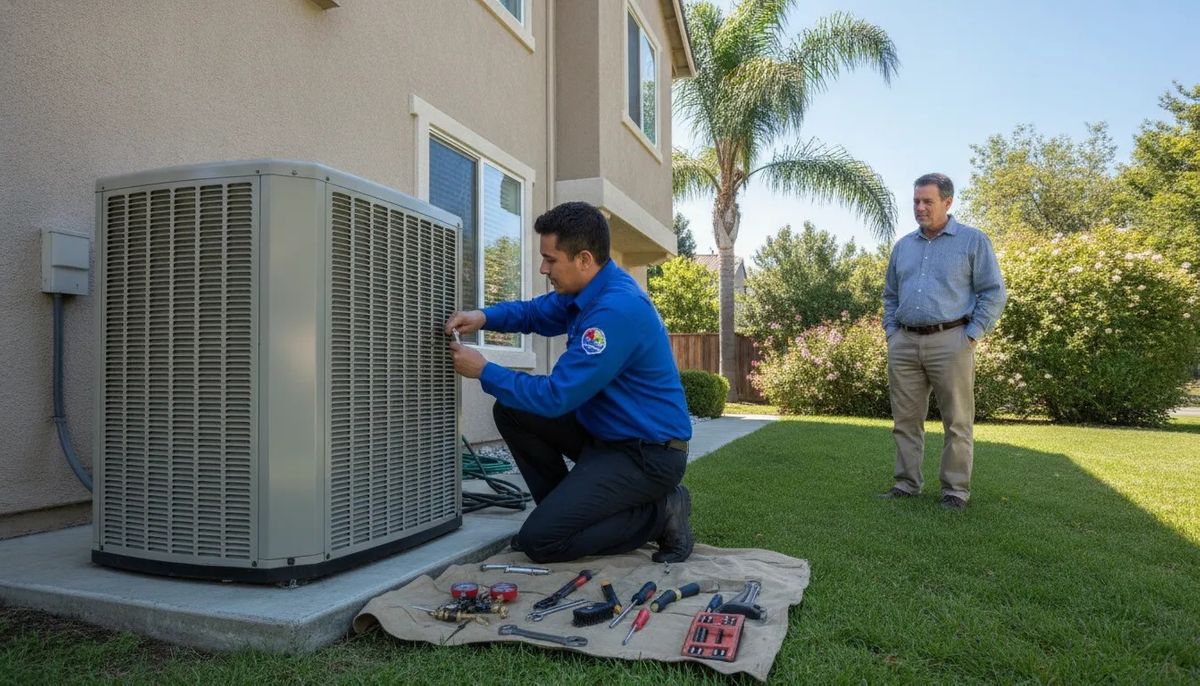
A heat pump that stops reaching the thermostat setting, cycles repeatedly, or begins making unusual sounds may have an airflow, electrical, refrigerant, or component problem.
The symptom can point you toward a concern, but it cannot identify the cause safely without testing the system.
For heat pump repair Concord homeowners can rely on, the right next step is a paid diagnostic service call. The visit evaluates the equipment and explains the findings.
Ortiz then provides a transparent repair estimate before work begins. Ortiz Heating and Air Conditioning handles ducted and ductless heat pumps for homes and light commercial properties across the Bay Area.
Before scheduling service, note when the problem occurs. Check that the thermostat is set appropriately. Avoid opening electrical panels or handling refrigerant.
A careful diagnosis begins by separating normal heat-pump behavior from signs that require professional attention.
Request an HVAC service call from Ortiz
How Heat Pump Repair Concord Visits Start With the Right Diagnosis
Pay attention to changes in how your heat pump runs, not just whether it turns on. A sudden increase in electricity consumption can indicate insufficient maintenance or a malfunction. This is especially relevant when it appears alongside comfort or airflow changes.
A qualified HVAC professional should evaluate the system when these patterns persist. The same symptom can have more than one possible cause.
Warning signs homeowners can observe
Keep a short record of what you notice, including when the issue began, whether it occurs during heating or cooling, and what the thermostat displays. Useful warning signs include:
The system does not operate, or it repeatedly cycles on and off.
Indoor temperatures never reach the thermostat setpoint.
Humidity remains unusually high, even when the system is running.
The unit or ductwork produces excessive noise or unfamiliar smells.
The thermostat shows auxiliary heat continuously instead of only when supplemental heat is needed.
You can see ice or frost covering the indoor or outdoor coils.
Filters or coils appear dirty, or mold is growing near or around the heat pump.
These signs are identified in a homeowner guide from the U.S. Department of Energy's Building Science Education and Research program. They point to the need for a proper evaluation. They do not identify the failed component by themselves.
For example, poor comfort could relate to airflow, controls, maintenance, or another system condition.
What is urgent and what to avoid
Arrange a service call promptly when the heat pump stops maintaining a safe, comfortable indoor temperature. This includes running continuously without reaching the setpoint. It also includes developing a strong or unusual odor, or showing visible ice, moisture, or mold around the equipment.
If you notice smoke, scorching, sparks, or a burning electrical smell, turn the system off if it is safe to do so. Seek professional help rather than continuing to operate it.
Homeowners can note thermostat settings and check whether a filter is visibly dirty. Keep furniture or other obstructions away from supply registers.
Do not open electrical panels, handle refrigerant, scrape ice from coils, bypass safety controls, or take apart the outdoor unit. Those steps can create safety risks. They may also hide the evidence a technician needs for an accurate diagnosis.
For more context on heat pump repair and maintenance, Ortiz can inspect ducted or ductless equipment.
The team can explain the next step based on the equipment's actual condition. The goal of heat pump repair in Concord is not to guess from a symptom. It is to connect the observed problem with verified testing before repair options are discussed.
Which Heat Pump Behaviors Are Normal in Concord Homes?
Heat pumps do not operate exactly like furnaces. An air-source heat pump moves heat from outdoor air into the home during colder weather, then reverses that process to provide cooling.
It uses electricity to move heat rather than generate heat directly. As a result, steady, lower-intensity airflow can be normal instead of the short bursts of very hot air some homeowners expect from a furnace. A homeowner guide from the Building Science Education and Research program describes this consistent airflow and continuous operation as typical heat-pump behavior.
The sound and timing of operation can also depend on the equipment. Inverter-driven or multi-speed compressors can adjust output as outdoor temperatures change. A single-stage heat pump does not vary its output in the same way.
It may run at one consistent capacity. Neither pattern alone confirms a fault. The more useful question is whether the system maintains the setpoint and delivers consistent comfort without unusual noise, odor, or other changes.
Thermostat settings matter
Heat pumps generally respond best to steady thermostat settings. Avoid abrupt changes of 3 degrees Fahrenheit or more when the home is unoccupied, and make smaller adjustments when changing the setting for nighttime comfort.
A backup or auxiliary heat indicator may appear under some conditions. Constant auxiliary heat, an inability to reach the setpoint, or frequent cycling deserves attention rather than assumption.
Ducted and ductless systems may feel different
In a ducted system, air moves through supply registers and return grilles, so a homeowner can check that furniture, rugs, or other objects are not blocking them. Ductless systems distribute air from indoor wall-mounted units.
A ductless thermostat measures temperature at the indoor unit. Its reading can differ from the temperature where people sit, especially when the unit is mounted high on a wall. The guide notes that a small adjustment may be needed for that setup.
Confirm the thermostat is in the intended mode and that the setpoint is reasonable.
Check that registers, grilles, or indoor-unit filters are not visibly blocked or heavily dirty.
Look around the outdoor unit for obvious obstructions that could restrict airflow.
Note unusual smells, excessive noise, repeated short cycles, or a setpoint that is never reached.
These are observation-level checks, not a substitute for opening the equipment or handling refrigerant and electrical components. If comfort declines or the system behaves differently from its normal pattern. Professional heat pump repair in Concord can identify whether the cause is airflow, controls, or another component.
What Does a Professional Heat Pump Diagnostic Visit Include?
A professional diagnostic visit is designed to identify how your heat pump is operating before anyone recommends a repair. The service call has a fee, and that diagnostic or service fee is separate from the cost of repair work that may be recommended afterward. Ortiz provides a transparent estimate before repair work begins, so you can understand the proposed work and make an informed decision.
Review the symptoms and system history. The technician begins by discussing what you have noticed, such as poor heating or cooling. Unusual cycling, noise, odors, or a thermostat that does not reach the selected setting. Information about recent maintenance, prior repairs, and when the problem started can help focus the inspection. Because ducted and ductless systems operate differently, the technician also considers the equipment type and how it serves the home or business.
Observe operation and check performance. A qualified professional evaluates whether the system starts, runs, and changes modes as expected. The inspection may include checking airflow, since restricted or inadequate airflow can affect comfort and overall operation. The technician may also examine the indoor and outdoor coils and clean them when appropriate. These checks help distinguish a control issue, airflow concern, maintenance need, or equipment fault instead of relying on a symptom alone.
Test the refrigerant circuit. The service checklist can include verifying that the heat pump has the proper refrigerant charge and checking for refrigerant leaks. A low charge is not a complete diagnosis by itself, because a leak or another system condition may need attention. Refrigerant work should be handled by a qualified professional rather than attempted as a homeowner repair.
Inspect drainage and electrical connections. The technician may clean the condensate drain pan and check for clogs. Electrical terminals are also inspected as part of the service evaluation. These checks matter because drainage and electrical conditions can affect safe, reliable operation, but they require appropriate tools and training. Do not open electrical compartments or attempt refrigerant work to investigate the problem yourself.
Explain the findings and next step. After testing, the technician should explain what was found, what remains uncertain, and whether repair is practical based on the equipment's condition. Ortiz's professional HVAC repair services include component-level troubleshooting, while an HVAC service call provides the appropriate starting point when the cause is not yet clear. The resulting repair estimate is for the recommended work, not a promise that every diagnostic visit will lead to the same solution.
Common Heat Pump Repairs and What They May Indicate
A heat pump symptom can point to more than one possible repair area. For example, weak airflow may relate to a filter, blower motor, duct restriction, or another operating condition. A thermostat message may reflect controls, wiring, or a problem elsewhere in the system. The purpose of a professional evaluation is to test the equipment and identify the actual cause, rather than replace a part based on a symptom alone.
Ortiz provides component-level troubleshooting for ducted and ductless heat pumps, including systems from different brands and models. The categories below describe what a technician may evaluate during a service call. They are not a remote diagnosis of any particular home.
Heat pump repair areas and testing checks
Observed concern: Hard starting, unusual outdoor-unit sounds, or no cooling or heating Possible area to evaluate: Compressor and related controls Why testing matters: Compressor operation can be affected by electrical or refrigerant conditions, so testing helps separate the source of the problem.
Observed concern: Reduced comfort, long run times, or a frozen coil Possible area to evaluate: Refrigerant charge or a leak Why testing matters: A technician can check the charge and look for leaks before determining whether repair work is appropriate.
Observed concern: Intermittent operation, tripped protection, or failure to start Possible area to evaluate: Electrical components, terminals, wiring, and controls Why testing matters: Electrical terminals and system components require measured testing. Visual inspection alone may not identify the fault.
Observed concern: Weak airflow or uneven temperatures Possible area to evaluate: Blower motor, filter, ductwork, or airflow restrictions Why testing matters: Verifying airflow helps determine whether the issue is at the air handler, in the distribution system, or caused by a restriction.
Observed concern: Incorrect temperatures, frequent cycling, or persistent auxiliary heat Possible area to evaluate: Thermostat settings, thermostat operation, or system controls Why testing matters: Control signals and settings should be checked alongside equipment performance before a thermostat is replaced.
Observed concern: Reduced heat transfer or repeated icing Possible area to evaluate: Indoor or outdoor coils Why testing matters: Coil condition and cleanliness can affect operation. A service check may include inspecting and cleaning both coils.
Observed concern: Water near the indoor unit, staining, or moisture concerns Possible area to evaluate: Condensate drain pan, drain line, or blockage Why testing matters: Checking the pan and drainage path helps identify clogs. It can also reduce the risk of water damage or mold-related conditions.
These repair categories can overlap. A refrigerant concern, restricted airflow, or electrical fault may create similar comfort symptoms, while a drainage issue may be separate from the heating or cooling complaint. If the system is not operating properly, a qualified technician should inspect it and explain the findings before repair work proceeds.
When Is Repair Better Than Heat Pump Replacement?
The right choice depends on what the inspection finds, not on a universal age rule. A heat pump with a limited, repairable issue may continue serving the home reliably after component-level work. Replacement may deserve consideration when the system has several problems, repeated failures, or a condition that makes another repair unlikely to address ongoing comfort concerns.
Consider the system's age and overall condition
Age is useful context, but it should not make the decision by itself. The technician should evaluate the condition of the indoor and outdoor equipment, the quality of previous repairs, airflow, controls, and the system's operating performance. A well-maintained heat pump with one isolated fault may be a reasonable repair candidate. A system with widespread wear may call for a broader replacement discussion even if one immediate component can be repaired.
Look for patterns instead of one isolated failure
One malfunction does not automatically mean the equipment should be replaced. However, recurring breakdowns can change the decision. If the same system has needed several repairs, regularly loses comfort, or requires repeated troubleshooting, ask what is driving the pattern. The issue could involve the equipment itself, airflow, controls, installation, or another part of the system. Testing is important because replacing one component without understanding the larger problem may not resolve the underlying concern.
Compare comfort, fit, and available parts
A repair discussion should include how well the heat pump meets the home's needs. Uneven temperatures, persistent humidity concerns, excessive cycling, or frequent auxiliary heat may indicate that the system requires more than a single component repair. The technician can also confirm whether suitable replacement parts are available and whether the current equipment remains a good fit for the ductwork. Zones, controls, and space it serves. Ducted and ductless systems can require different solutions, so the system layout matters.
Ortiz provides heat pump diagnosis and repair for ducted and ductless systems, along with repair-versus-replacement recommendations based on inspection. For a broader decision framework, review whether to repair or replace. The goal is a clear choice supported by the equipment's condition, repair history, comfort performance. Parts availability, and the scope of work required, rather than a recommendation made from symptoms alone.
How to Prepare for Service and Reduce Repeat Problems
A well-prepared diagnostic visit gives the technician better context and helps keep the evaluation focused. Before scheduling heat pump repair in Concord, gather a few details and make the equipment easy to inspect.
Write down the symptoms and timing. Note whether the system is not reaching the thermostat setting, cycling frequently, making unusual sounds, producing uneven temperatures, or displaying auxiliary heat. Record when the issue began, whether it follows a change in weather or thermostat settings, and whether it affects every room or only one zone. Photos of thermostat messages can also help, provided they do not replace an in-person evaluation.
Gather the system records. Have the model and serial numbers, installation or replacement paperwork, prior service invoices, and any available warranty documents ready. These records can help establish the equipment's age and service history. Manufacturer specifications and warranty terms may also determine the recommended maintenance interval. A federal homeowner guide notes that many heat pumps are checked every one to two years, but the manufacturer's instructions and warranty requirements take priority. Review the source guidance on heat-pump maintenance.
Check the filter and clear access. Replace or clean the filter according to the equipment manufacturer's instructions. As general guidance, ducted-system filters may need attention about every 90 days, while ductless filters may need cleaning at least monthly. Clear stored items, furniture, or landscaping that prevents access to the indoor or outdoor unit. Do not remove electrical panels or attempt refrigerant work yourself.
Show the technician the full system. Identify the thermostat, indoor air handler, outdoor unit, return grilles, supply registers, and any areas with water, unusual odors, or airflow changes. For ductless equipment, mention which rooms or zones are affected. Access to each relevant component helps the technician evaluate the system rather than focusing on one visible symptom.
Ask what testing found and what happens next. Request a clear explanation of the diagnosed problem, recommended repair, other conditions discovered, and the risks of delaying action. Ask whether the recommendation is based on testing, whether parts or manufacturer support may affect the repair, and how to prevent a repeat issue. A service call for repair diagnosis has a fee, and Ortiz provides transparent repair estimates before work begins.
For maintenance planning, review annual heat pump maintenance. When you are ready to arrange a professional evaluation, contact Ortiz to request an HVAC service call.
Frequently Asked Questions
Can a heat pump be repaired?
Often, yes. Repair depends on what testing finds and the condition of the system. Common repair areas include electrical components, refrigerant leaks, blower motors, compressors, and thermostats. A qualified technician should confirm the cause before recommending a repair, replacement, or further monitoring. Ortiz diagnoses and repairs both ducted and ductless heat pumps across Concord and the surrounding Contra Costa County area.
How much does a heat pump service call cost?
The cost depends on the diagnostic policy and scope of the HVAC company you choose. At Ortiz, a repair evaluation is a paid diagnostic service call, and the technician provides a transparent estimate before repair work begins. Ask what the service call includes, whether additional testing could be needed, and whether the diagnostic fee may be credited toward an approved repair. Repair estimates should not be described as free.
What should I check before scheduling heat pump repair?
Confirm that the thermostat is set to the desired mode and temperature, the system has power, and the air filter is not visibly blocked. Note when the problem occurs, whether the outdoor unit runs, and whether you hear unusual sounds or smell anything abnormal. Do not open electrical panels, handle refrigerant, or attempt repairs yourself. Those steps require appropriate training and equipment.
How do I know whether to repair or replace my heat pump?
Consider the system's age and condition, the frequency of failures, comfort problems, parts availability, and the scope of the recommended work. A repair may make sense when the issue is isolated and the equipment remains in sound condition. Replacement may deserve consideration when problems recur or major components are failing. An inspection is needed to make that comparison responsibly.
Schedule a Heat Pump Service Call in Concord
A professional evaluation can help clarify whether your heat pump needs a targeted repair or a broader recommendation based on its condition. To request a service call for your heat pump concern, contact Ortiz and share the symptoms you have noticed.