
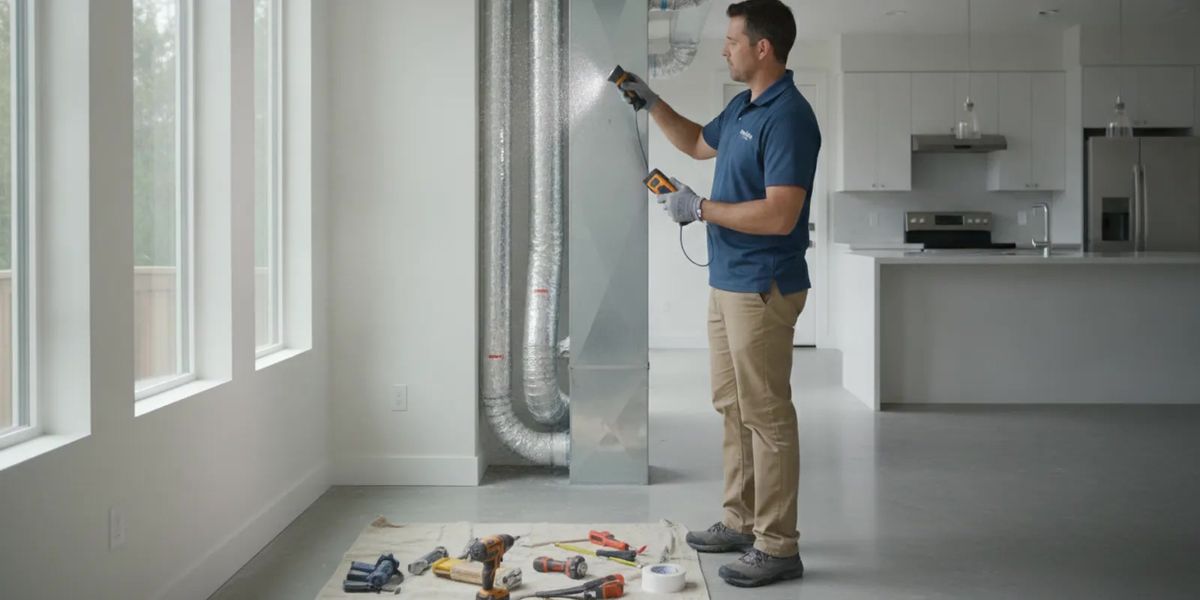
Duct repair in San Mateo homes can range from sealing a loose connection to correcting a crushed or poorly supported duct run. Because ductwork is hidden in ceilings, floors, walls, attics, and crawlspaces, the first clue is often a room that feels different from the rest of the home. Knowing what to observe, what an inspection should clarify, and when repair is more sensible than replacement can help you plan a practical next step.
What Does Duct Damage Look Like in a Home?
Ducts carry heated or cooled air from the HVAC equipment to the rooms it serves, then provide a return path for air to move back through the system. A damaged, disconnected, restricted, or leaking section can interfere with that route. Symptoms are useful clues, but they do not prove that a duct is the cause. A dirty filter, closed register, equipment problem, insulation issue, or room layout can produce similar comfort complaints.
Notice whether the problem is limited to one room or affects the whole home. A single weak supply register may point toward a local restriction or loose branch. Several rooms with weak airflow, persistent dust, or unusual system operation call for a broader assessment. Write down when you notice the issue, whether it changes with heating or cooling, and which registers seem affected. This gives a technician a useful starting point.
Uneven airflow: One room receives noticeably less air than nearby rooms, or airflow varies sharply from one register to another.
Unexpected temperature differences: A room remains warm or cool despite normal operation elsewhere. Sun exposure, windows, insulation, and duct routing can also contribute.
Visible damage: An accessible duct section looks crushed, torn, disconnected, or poorly supported.
Air movement in an unintended area: You feel air near a joint, attic, crawlspace, or utility area when the system is running.
Unusual sounds: Rattling, whistling, or a change in sound near a duct may indicate a loose panel, restriction, or pressure issue, but needs evaluation.
Do not assume that dust around a register means the duct needs repair, or that duct cleaning will solve a leak. Repair addresses a physical or airflow problem, while cleaning removes accumulated material from accessible duct surfaces. If you are unsure which issue applies, describe the symptoms and ask for an assessment rather than choosing a remedy based on one clue. For general background on household energy use and efficiency, the U.S. Department of Energy is a useful government resource.
What Can Cause a Duct to Need Repair?
Duct problems may develop at connections, bends, transitions, or long unsupported runs. Flexible duct can become compressed or kinked if it is moved, crowded, or not supported as intended. Metal duct sections can separate at joints or develop damage. Older or poorly sealed connections may allow air to escape into an attic or crawlspace instead of reaching the room. Work in a ceiling or crawlspace can also disturb ductwork.
Not all airflow problems come from a hole. A duct can be intact yet restricted by a sharp bend, a closed damper, an obstructed register, or an arrangement that does not deliver air evenly. Return-air limitations may also affect how air circulates. The right remedy depends on locating the source instead of treating the symptom alone.
For a first look, check only accessible areas that are safe to reach. Confirm that supply registers are open and not blocked by rugs or furniture. Replace a filter according to its condition and the equipment instructions. From a safe standing position, look for obvious damage around exposed duct connections. Avoid climbing into an attic or crawlspace, moving insulation, handling wiring, or attempting repairs in confined or hazardous areas. Hidden ductwork and system performance require a more complete inspection.
How Is Ductwork Inspected?
A useful inspection starts with your description of the rooms, timing, and operating conditions. The technician can compare the reported symptoms with the system layout and examine accessible duct sections, connections, supports, registers, and returns. They may also consider whether the equipment is operating normally and whether a filter or obstruction could be affecting airflow.
Ask what was inspected and what evidence supports the recommended work. A clear explanation should identify the affected location, the type of defect, and the proposed correction. If access is limited, ask which areas could not be seen and whether that uncertainty affects the recommendation. For a concern that involves multiple rooms, the technician should explain whether the proposed work addresses the full airflow path or only one accessible section.
Ortiz offers duct services for homeowners who need help evaluating ductwork. If the symptoms might relate to the HVAC equipment rather than the ducts, a broader HVAC repair assessment may be appropriate. Diagnostic visits for repairs are not the same as a free estimate for adding or replacing equipment.
Which Duct Repair May Fit the Problem?
Repair should match the defect. A localized connection that has separated may need to be reconnected and secured. A leak at a joint may call for appropriate sealing. A compressed section may need its routing or support corrected, while a damaged section could require replacement of that segment. If the layout itself is contributing to persistent airflow issues, the technician may need to discuss adjustments beyond a simple patch.
Sealing is not a substitute for correcting a disconnected or structurally damaged duct. Likewise, replacing one section does not automatically solve an imbalance caused by other parts of the system. Ask whether the proposed work is a targeted repair, a broader duct modification, or a recommendation to replace aging or extensively damaged ductwork. These are different scopes, and the explanation should make that distinction clear.
Finding or condition: Loose or separated connection Possible response: Reconnect and secure the joint, then seal as appropriate What to clarify: Where the separation is and whether nearby connections also need attention
Finding or condition: Leak at a joint or seam Possible response: Seal the identified leak with a suitable method What to clarify: How the leak was located and whether the duct material is still sound
Finding or condition: Crushed or kinked flexible duct Possible response: Correct the routing or support, or replace the damaged portion What to clarify: Whether the restriction can be removed without creating a new bend or strain
Finding or condition: Torn, badly deteriorated, or repeatedly failing section Possible response: Replace the affected section or compare repair with a wider replacement scope What to clarify: Why a patch is not durable and how the replacement connects to existing ductwork
Finding or condition: Weak airflow with no visible defect Possible response: Check for restrictions, dampers, return-air issues, and equipment-related causes What to clarify: What alternatives were ruled out before recommending duct work
The table is a guide to questions, not a diagnosis. Duct materials and access vary from home to home. A repair plan should take account of the location, condition, accessibility, and relationship between the affected section and the rest of the system.
When reviewing a proposal, look for a description of the problem and the work, not only a general label such as duct repair. For example, “seal a leak” does not tell you which connection will be sealed or whether the duct itself is damaged. “Replace a section” should identify the approximate location and explain why that segment cannot be repaired. If more than one issue was found, ask which items are necessary to address the reported symptom and which are recommendations for a separate concern.
Access can affect the scope. A duct that is exposed in a utility area may be straightforward to examine, while a run behind a finished ceiling may require more investigation or access work. Ask whether the proposed scope includes opening and restoring any surfaces, or whether that is excluded. This is a practical way to understand what the work involves before scheduling it. Repair pricing and diagnostic charges depend on the actual service; avoid treating an equipment-installation estimate as a repair quote. Ortiz charges diagnostic fees for repair service calls, while free estimates apply to equipment installation or replacement.
After the work, ask what you should check in the affected room and whether any further observation is recommended. Improved airflow may be apparent at a register, but room comfort can also depend on insulation, windows, doors, and system operation. If a symptom persists, share that information with the contractor so the next assessment can build on what was already found.
When Is Repair Enough, and When Should You Consider Replacement?
A targeted repair may be a reasonable option when the defect is isolated, the surrounding duct is in serviceable condition, and the repair can restore the intended connection or airflow path. Replacement may deserve consideration when damage is widespread, sections are badly deteriorated, repeated repairs have not held, or the existing configuration continues to restrict airflow. These are not automatic rules: the technician should show what is damaged and explain why one scope is preferable to another.
Compare recommendations by scope, not just by the name of the job. Ask which sections will be repaired or replaced, what access is included, whether sealing or support corrections are part of the work, and how the system will be checked afterward. If only a small area is visible, ask how the contractor reached a conclusion about more extensive replacement. A written description helps you compare proposals on the same basis.
Duct repair and full HVAC replacement are also separate decisions. If the equipment is aging or not meeting comfort needs, that may lead to a separate conversation about system options, but duct symptoms alone do not establish that the HVAC unit must be replaced. Ortiz provides HVAC installation services for equipment projects. For equipment additions or replacement, ask for a clearly scoped estimate; the company offers free estimates for those installation and replacement projects, not for repair diagnostics.
What Should San Mateo Homeowners Ask Before Approving Work?
Before authorizing a repair, make sure you understand the finding and what the proposed work is intended to change. Useful questions include:
Which specific duct section or connection is damaged, restricted, or leaking?
What did you observe that supports the diagnosis?
Is this a localized repair, a replacement of one section, or a larger duct modification?
Are there access limits or hidden areas that could not be inspected?
Will the work address a symptom in one room or a problem affecting multiple rooms?
How will the completed work be checked, and what result should I expect to observe?
Does the proposal include the necessary access, reconnection, support, and sealing, or are any of those separate?
There is no need to diagnose hidden ducts yourself. A few observations and direct questions can make the visit more productive. If service availability is a consideration, Ortiz's San Francisco Peninsula service area page provides regional service information. You can also review the company's HVAC maintenance services if you want to discuss ongoing system care; maintenance is distinct from repairing a confirmed duct defect.
How Can You Reduce the Chance of Future Duct Problems?
Keep supply and return registers unobstructed, and replace the HVAC filter as needed based on its condition and the equipment guidance. If work is planned in an attic, crawlspace, or ceiling where ducts are present, let the contractor know about the duct route and ask that it be protected. After a repair, pay attention to the rooms that prompted the visit. Note whether airflow or comfort changes, and report any remaining symptoms rather than assuming the issue has been resolved.
Routine HVAC care can help identify visible concerns, but it cannot guarantee that hidden ducts will never leak or become damaged. If you schedule regular system service, mention rooms with recurring temperature differences or unusual airflow. Ortiz also shares general guidance in its HVAC homeowner blog. For information about the company's background and approach, see About Ortiz Heating and Air Conditioning.
Talk with Ortiz about a duct repair concern
Frequently Asked Questions
Can weak airflow in one room mean a duct is damaged?
It can, but it is only one possible cause. A blocked register, closed damper, restriction, return-air issue, equipment concern, or room characteristics can also affect comfort. An inspection can help distinguish among them.
Is duct sealing the same as duct repair?
No. Sealing addresses air leakage at a suitable joint or seam. Repair can also involve reconnecting, supporting, rerouting, or replacing a damaged section. The right work depends on the condition and location of the defect.
Should I clean the ducts if I suspect a leak?
Cleaning and repair address different conditions. Cleaning removes accumulated material from duct surfaces; it does not reconnect a separated section or correct a leak. First identify the issue and then choose work that addresses it.
Can I repair a duct myself?
You can check that accessible registers are open and clear, but hidden ductwork may be difficult or unsafe to reach. Avoid entering confined spaces or handling equipment components. Ask a qualified HVAC professional to inspect and correct damage that is not safely accessible.
Does every damaged duct need full replacement?
No. An isolated, repairable defect may call for a targeted correction. Replacement may be considered when damage is extensive, the duct is deteriorated, or repeated repairs have not addressed the problem. Ask the technician to explain the evidence and compare the scopes.
Plan Your Next Step for Duct Repair in San Mateo
If you have noticed uneven airflow or visible duct damage, document which rooms are affected and when the problem occurs. Then contact Ortiz Heating and Air Conditioning to discuss an appropriate assessment and the next step for your home.