
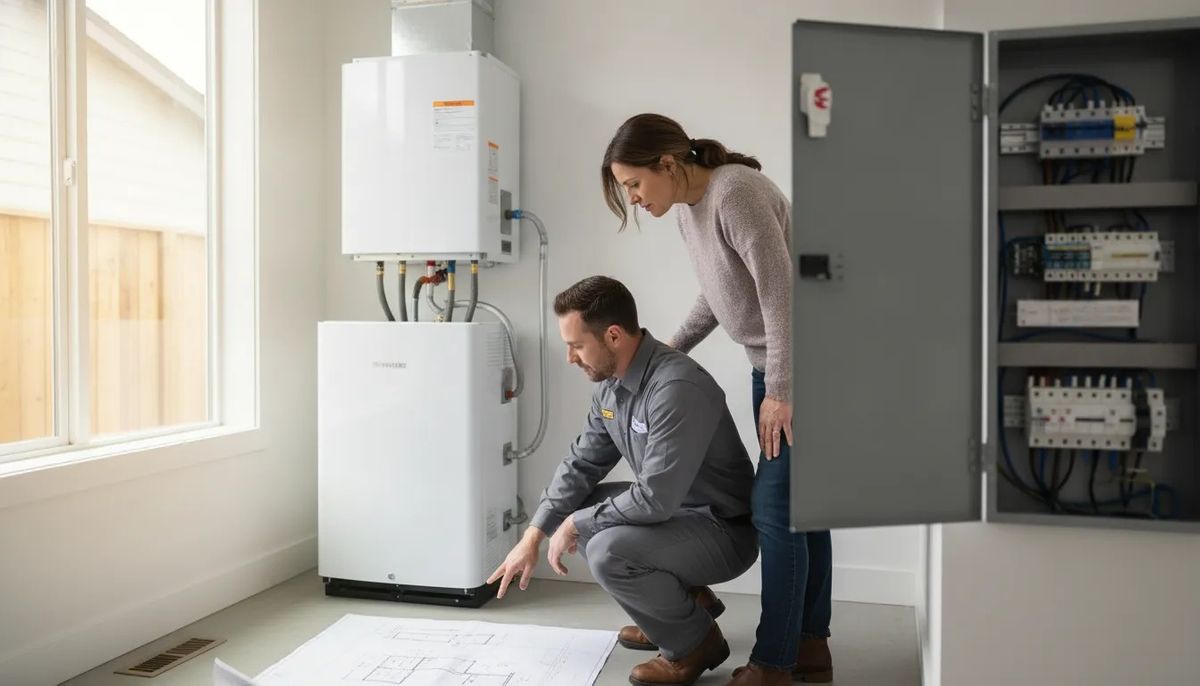
A heat pump upgrade can be a focused HVAC replacement or one part of a broader plan to move a home toward electric equipment. In the Bay Area, the right starting point depends on the home itself. An older, space-constrained San Francisco property may face different questions than a townhouse on the Peninsula or a home in the hotter inland East Bay.
Request a heat pump installation assessment
This bay area home electrification guide explains how to evaluate panel and service capacity, ductwork, insulation, layout, project phasing, and current incentive requirements before choosing equipment. A licensed HVAC assessment can connect those details to the home's heating and cooling load, meaning the amount of conditioning the space actually needs. That approach avoids assuming every project requires a panel upgrade or whole-home retrofit.
With that practical framework in place, it helps to define what electrification includes and how an HVAC upgrade fits within the larger picture.
How This Bay Area Home Electrification Guide Helps
In brief: Home electrification means planning how a home can use electric equipment for heating, cooling, water heating, cooking, transportation, and possibly solar generation. It does not automatically mean replacing every gas appliance at once. For many homeowners, the first step is a heat pump upgrade evaluated alongside the home's electrical service, ducts, insulation, layout, and future plans.
That distinction matters in the Bay Area. A compact older home in San Francisco may have limited equipment space and aging infrastructure. A Peninsula townhouse may have different electrical, duct, and installation constraints. An inland East Bay home may face hotter summer conditions than a coastal property. The right plan must respond to the actual building rather than assume that every address needs the same equipment or sequence.
Electrification is a planning umbrella, not a single project
A heat pump is often the most visible HVAC-related part of an electrification plan. In heating and cooling, the system transfers heat rather than creating heating in the same way as a conventional furnace. A properly planned heat pump project still depends on the home's heating and cooling needs, property size, insulation, layout, and existing distribution system. The goal is not simply to install an electric appliance. It is to match equipment and delivery to the way the home actually performs.
A broader plan may consider several separate decisions:
Heating and cooling: Replacing aging equipment with a heat pump or evaluating whether a heat pump fits the home's comfort needs.
Water heating: Considering a heat pump water heater as a separate equipment decision with its own space, installation, and electrical questions.
Cooking: Reviewing whether an electric or induction cooking appliance fits the kitchen, household preferences, and available circuits.
Transportation: Planning for an electric vehicle charger if a homeowner expects to add one, rather than treating it as an unrelated future surprise.
Solar and efficiency: Evaluating solar generation or efficiency improvements as connected planning choices, not automatic requirements for a heat pump installation.
These choices can be made together or in phases. Existing equipment, available space, electrical capacity, duct condition, and the homeowner's timing all influence the practical path. A heat pump retrofit should therefore be evaluated in the context of the home's current equipment and infrastructure, rather than as a universal package.
For homeowners comparing systems, the distinction between a focused HVAC upgrade and a whole-home plan is a useful starting point. A focused project may address comfort and equipment replacement now while documenting questions for later. A whole-home approach may coordinate heating and cooling with water heating, cooking, vehicle charging, solar, and building improvements. Neither approach is automatically correct. A site-specific review can clarify which decisions are connected, which can wait, and which constraints should be addressed before equipment is selected.
Is Your Electrical Panel Ready for a Heat Pump?
A heat pump does not automatically require a new electrical panel. Readiness depends on the home's existing equipment, the electrical load already served, the capacity of the panel and service, and the specific heat pump selected. Older Bay Area homes, condos, and space-constrained properties can have very different conditions, so a visual assumption is not enough. A careful review helps separate a manageable equipment installation from a project that needs electrical coordination first.
What This Bay Area Home Electrification Guide Should Check
Think of the electrical review as a capacity and coordination exercise, not a default upgrade. The panel distributes power to individual circuits, while the home's service determines how much electricity can be delivered to the property. A heat pump also needs an appropriately sized circuit, an accessible disconnect, and installation that follows applicable electrical and mechanical requirements. The exact requirements depend on the equipment and the site. The following checklist is for planning a conversation with qualified professionals, not for homeowner electrical work.
Document the existing electrical system. Note the panel location, service size if it is known, available breaker spaces, and major equipment already connected. Existing electric heating, water heating, cooking equipment, an electric vehicle charger, or other high-demand loads can affect the overall review. Do not remove covers, move breakers, or inspect energized components yourself.
Review the proposed heat pump's electrical requirements. The installer should identify the equipment's circuit requirements, operating characteristics, disconnect location, and any related controls. A circuit requirement for one product should not be treated as a universal rule for every heat pump. Competitor research often cites precise requirements for particular products, but those examples are product-specific and must be confirmed against the selected equipment documentation.
Evaluate panel capacity and available circuits. Electrical capacity is a project variable that should be assessed before adding major electric equipment. A panel upgrade may be needed if the existing panel cannot support the proposed load, but it is not automatically required for every electrification project. An electrician can perform the appropriate load review and determine whether the existing panel, a circuit reconfiguration, or another permitted solution is suitable.
Separate panel capacity from utility service capacity. A panel can have physical space for a breaker while the property's overall service still needs evaluation. Conversely, a crowded-looking panel does not by itself prove that a utility service upgrade is required. If calculated demand exceeds available service capacity, coordination with the serving utility may become a separate part of the project. Treat that possibility as site-specific, not as a prediction.
Coordinate the HVAC and electrical assessments. Have the HVAC professional confirm sizing, placement, controls, and installation conditions while the licensed electrician reviews the electrical side. Home performance testing can also measure delivered HVAC capacity and help identify inefficiencies, rather than relying only on equipment labels or occupant impressions. Ortiz's installation planning process considers property size, insulation, layout, electrical connections, and existing system conditions.
Confirm the installation path before work begins. Ask which professional will handle each portion of the scope, where the disconnect will be located, whether permits or utility coordination apply, and what assumptions are included in the written plan. Keep any electrical changes with a properly licensed electrician. A clear scope prevents a panel discussion from turning into an unexpected project change after equipment has been ordered.
This review is especially useful in a broader electrification plan, but it does not obligate a homeowner to electrify every system at once. The right outcome may be a heat pump installation using the existing service, a coordinated electrical adjustment, or a phased plan that addresses another household load first. The decision should follow the home's measured needs and the selected equipment, not a one-size-fits-all rule.
How Ducts, Insulation, and Layout Affect the Upgrade
A heat pump does not operate in isolation. Its performance depends on how much heating or cooling the home needs, how well the building holds conditioned air, and how effectively the distribution system delivers that air to each room. That is why a responsible upgrade review looks beyond the equipment nameplate. A retrofit should be evaluated in the context of the home's existing equipment and infrastructure, rather than treated as a universal configuration.
The first concept to understand is load. Heating and cooling load is the amount of capacity a home needs under expected conditions. Property size matters, but it is only one part of the picture. Insulation levels, window exposure, air leakage, ceiling height, room arrangement, and the local climate all influence the load. A home near the coast may face different heating and cooling conditions from a home in a hotter inland East Bay neighborhood. Older San Francisco housing may also have tight equipment closets, unusual additions, or limited pathways for ductwork.
Duct condition and design are equally important. Leaks, crushed sections, inadequate insulation, restrictive transitions, or poorly located returns can affect how air moves through the home. A system can be correctly selected and still leave rooms uncomfortable if the distribution network is undersized or unbalanced. Ortiz's ductwork assessment and services can be part of that planning conversation, including situations where a challenging layout calls for duct redesign rather than a simple equipment swap.
What to ask about before choosing equipment
Insulation and air leakage: Ask whether the attic, walls, crawlspace, and other envelope areas are reasonably prepared. Also ask whether obvious gaps could let conditioned air escape.
Room-by-room comfort: Are certain rooms consistently too hot or too cold? Note when the problem occurs and whether it changes with wind, marine weather, or inland heat.
Duct condition: Are ducts accessible, sealed, insulated, and appropriately sized? Ask whether the existing return and supply layout can support the proposed system.
Equipment location: Is there enough clearance for service, airflow, drainage, and code-related requirements? In a condo or compact older home, location can shape the available options.
Layout changes: Have rooms, walls, windows, additions, or registers changed since the current system was installed? The original duct plan may no longer match the way the home is used.
Home performance testing can measure delivered HVAC capacity and help identify distribution problems that are not obvious from a thermostat reading. A licensed HVAC assessment should connect those observations to equipment sizing, duct decisions, insulation priorities, and the home's microclimate. Ortiz's Bay Area heat pump services provide a starting point for discussing an installation or replacement plan that fits the actual property, not a generic template.
Should You Electrify in Phases or Plan Whole-Home Improvements?
A practical Bay Area home electrification guide should leave room for more than one project path. Some homeowners replace heating and cooling first, then address water heating, solar, or other electric equipment as systems reach the end of their useful life. Others coordinate several improvements during one broader renovation. Neither approach is automatically better. The right choice depends on the home's existing infrastructure, the owner's timeline, the disruption the household can manage, and whether future equipment needs to work together.
Scope: A phased plan addresses one priority system or area at a time, such as HVAC, while documenting later needs. A whole-home plan reviews heating and cooling, water heating, electrical capacity, and other potential upgrades together.
Coordination: Phasing can simplify the immediate decision, but future work must account for equipment and infrastructure already installed. A whole-home plan allows equipment, circuits, duct changes, permits, and related construction decisions to be coordinated from the beginning.
Disruption: Phasing usually limits the work area and lets the household adapt between projects. A whole-home project may concentrate disruption into one renovation period, which can be useful when walls, ceilings, or utility areas are already open.
Budget timing: Phasing spreads decisions and project commitments over time, subject to changing equipment, program, and site conditions. A whole-home plan requires broader coordination at the outset and may make more decisions necessary before work begins.
Best fit: Phasing often suits an owner replacing failed or aging equipment, or a household with limited ability to renovate all systems at once. A whole-home plan often suits an owner planning a major remodel, multifamily improvement, or coordinated infrastructure project.
When does a phased plan make sense?
Phasing can be sensible when the existing furnace or air conditioner needs replacement, but other systems still have useful service life. It can also help when a homeowner wants to address comfort first and evaluate the next improvement after living with the new system. A phased plan is not the same as making isolated decisions. The first installation should be reviewed against likely future loads, available electrical service, equipment placement, duct design, and control strategy. That planning helps reduce the risk that a later project conflicts with today's choices.
Whole-home planning can be valuable when several systems are near replacement, when a renovation already involves electrical or mechanical work, or when the property has complex constraints. Single-family homes, condos, and multifamily buildings can have very different access, ownership, and scheduling issues. In rental or multifamily settings, the person paying utility bills may not be the person responsible for improvements, so owner and tenant needs should be addressed together. Guidance on existing multifamily electrification should address both policy considerations and hands-on technical implementation, rather than equipment selection alone.
Which system needs attention first, and what is its expected remaining service life?
Will today's equipment, duct changes, and electrical decisions support likely future upgrades?
Who owns the property, who pays utility bills, and who must approve or coordinate the work?
Can the household manage one concentrated disruption, or is a smaller project more realistic?
Have current utility, program, permit, and jurisdiction requirements been verified rather than assumed?
A licensed assessment can turn those questions into a sequence that fits the property instead of forcing every home into a universal retrofit order. A phased project should have a whole-home direction, while a whole-home project should still identify the most sensible first step.
Talk with Ortiz about your heat pump upgrade plan
Which Bay Area Rebates and Rules Should You Verify?
Incentives and permitting requirements can change the practical scope of a heat pump or broader electrification project, but they should never be treated as automatic. The program available to one Bay Area address may not apply to another because eligibility can depend on the serving utility or community choice energy provider. Eligibility can also depend on the equipment selected, household income, property type, local jurisdiction, and the date an application is submitted. Local rebates can vary by CCE provider, so confirm the program connected to your service address rather than relying on a neighbor's experience or an older project example.
Start with the current information from your utility, CCE provider, and the official program administrator. Some California programs have addressed solar and energy-efficiency improvements for qualifying low-income households, while other programs have focused on specific housing types or equipment. Program administrators publish current eligibility rules for qualifying households, housing types, and equipment. Check the current requirements before treating any program example as a match for your project. Those examples do not establish eligibility for a particular heat pump installation. Verify the current program rules, application windows, documentation, equipment requirements, and whether an installer must participate in the program.
Permits and code requirements also belong in the verification process. A local ordinance can be more stringent than statewide building or energy requirements, including Title 24, Part 6. That means the relevant city or county building department may matter as much as a statewide summary. Policy discussions may also refer to future changes affecting gas equipment, but a date mentioned online is not a promise about what applies to your home. Ask the authority having jurisdiction, or the qualified professional coordinating the project, which requirements are in effect when your permit is filed.
For a broader overview of incentive categories and homeowner questions, see the Bay Area heat pump rebates guide. Treat it as planning context, then confirm the latest details with the applicable official sources. Financing pilots and tariff-on-bill concepts may also be limited by location, program status, or participant eligibility. Check availability and terms directly before allowing a financing option to influence the project plan.
Homeowner verification checklist
Identify the electric utility and CCE provider serving the property address.
Check whether the equipment, contractor, property type, and household circumstances meet the current program rules.
Confirm application deadlines, required documents, reservation steps, and whether approval is needed before installation begins.
Ask the city or county building department about permits, inspections, and local amendments that may apply.
Verify whether the proposed equipment, electrical work, duct changes, or other improvements must meet specific code or program criteria.
Save the official program pages and written confirmations used for your decision, since requirements can change before a project is scheduled.
A site-specific plan should keep these policy questions separate from equipment selection. Confirmed eligibility can inform timing, but it should not drive a system choice that is unsuitable for the home's load, layout, electrical capacity, or comfort needs.
What Happens During a Licensed HVAC Readiness Assessment?
A readiness assessment turns a broad electrification goal into a practical project plan. It is not simply a quick look at the existing furnace. The contractor should evaluate how your home uses heating and cooling, how the building distributes conditioned air, and whether the supporting systems can accommodate the proposed equipment. That matters across the Bay Area, where older, space-constrained homes, newer townhomes, coastal conditions, and hotter inland neighborhoods can create very different installation questions.
Start with your comfort and project goals. The conversation should begin with what you want to improve. You may be replacing an aging system, adding cooling, reducing dependence on combustion, improving room-to-room comfort, or planning work in phases. Share recurring hot or cold rooms, noise concerns, indoor air-quality issues, and any planned remodeling. A useful assessment connects the equipment recommendation to the way your household actually uses the home rather than treating every property as the same.
Evaluate heating and cooling load and equipment sizing. Load means the amount of heating or cooling the home needs under local conditions. The assessment should consider property size, insulation levels, window exposure, layout, and the Bay Area microclimate before selecting capacity. Bigger is not automatically better. Correct sizing supports dependable comfort and helps the system operate as intended. Ask the contractor to explain the sizing logic in plain language, including which assumptions could change the recommendation.
Review ducts and air distribution. Existing ducts may be reusable, repairable, or a reason to consider redesign, depending on their condition, design, and location. The review should look at accessible ductwork, airflow concerns, filters, and connections. If the home has difficult spaces or uneven comfort, discuss a HVAC installation and replacement assessment and a Bay Area heat pump services evaluation together, rather than choosing equipment before understanding distribution.
Check the building envelope and room layout. Insulation, windows, ceiling height, orientation, and the arrangement of rooms all affect how the system should serve the home. The contractor should identify conditions that may influence sizing, zoning, registers, or the sequence of improvements. This does not mean every home needs insulation work or a full redesign. It means the recommendation should account for the home that is actually there.
Coordinate electrical capacity and equipment location. The assessment should identify the proposed equipment's electrical connection requirements and compare them with the home's existing service, panel, and available circuits. A panel upgrade is not automatic, and the HVAC contractor may need to coordinate with a qualified electrical professional when changes are indicated. Also review outdoor unit clearances, indoor equipment space, condensate routing, access for maintenance, and any noise or appearance considerations.
Clarify permits, code questions, and the written scope. Before work begins, ask which permits, inspections, or jurisdiction-specific requirements may apply and who will coordinate them. Rules can vary and should be confirmed for the property. The final written scope should identify equipment, sizing basis, duct or electrical work, location, controls, permit responsibilities, exclusions, and the project sequence. A contractor's qualifications provide useful context, but the written scope should still be specific enough for a homeowner to review and compare. An assessment or diagnostic visit is not automatically free. Free estimates apply to qualifying equipment installation or replacement work, while service and diagnostic visits carry a fee.
Request a heat pump installation assessment for your Bay Area home.
Frequently Asked Questions
Does every Bay Area heat pump project require an electrical panel upgrade?
No. Panel and service requirements depend on the home's existing capacity, other electrical loads, equipment selection, and available circuits. A readiness review should determine whether the current system can support the planned heat pump before anyone recommends an upgrade.
Can I install a heat pump if my existing ducts are older?
Possibly. Older ducts are not automatically disqualifying, but their condition, sizing, insulation, and layout affect comfort and system performance. An HVAC assessment can identify leakage, restrictions, or distribution problems and determine whether repairs, redesign, or replacement should be part of the project.
Is it better to electrify my entire home at once?
Not necessarily. Some homeowners coordinate heating and cooling with water heating, solar, or other improvements, while others phase the work around equipment age, available budget, construction access, and long-term goals. The best sequence depends on the property and the systems already in place.
How can I confirm which Bay Area electrification incentives apply?
Start with the current information from your utility or community choice energy provider. Then check the official state or local program page for eligibility, deadlines, equipment requirements, and application steps. Do not rely on an older rebate example, because program terms and local requirements can change.
What should a licensed HVAC assessment include?
It should review your comfort goals, property size, insulation, layout, existing equipment, heating and cooling loads, ductwork, electrical connections, equipment options, and applicable installation considerations. Ask for a clear written scope that separates recommended work from optional future phases.
Schedule Your Heat Pump Upgrade Assessment
A site-specific review can clarify equipment sizing, panel coordination, duct readiness, and whether a phased plan fits your home. To get started, request a heat pump installation or replacement assessment and quote through Ortiz. Free estimates apply to new or replacement equipment. Diagnostic and repair visits have a service fee, so the appropriate next step depends on the work your home needs.