
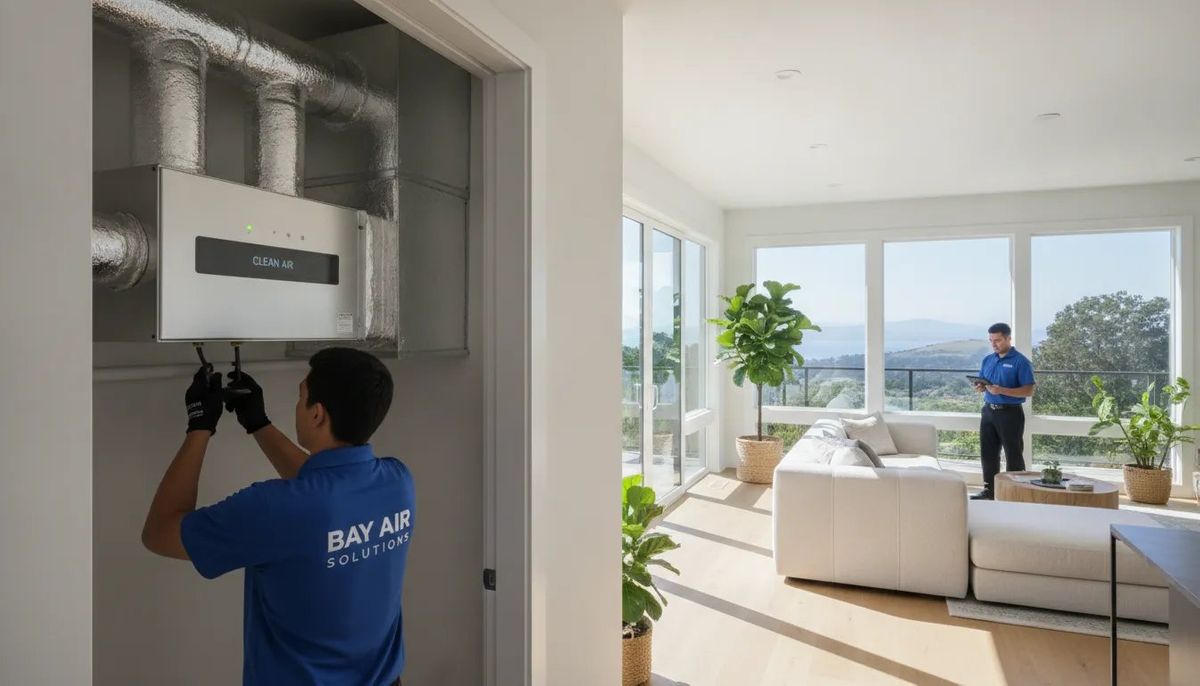
Bay Area homes face changing indoor air conditions throughout the year, from wildfire smoke and pollen to everyday dust and household particles. Choosing an air-cleaning technology is not simply a matter of picking the most advanced-sounding device. Each option works differently, and the right fit depends on your HVAC system, the pollutants you are trying to reduce, and how your home is ventilated.
An air scrubber HVAC system works with the home's central air system to treat air as it circulates, while portable or whole-home air purifiers primarily filter particles. UV germicidal lights use ultraviolet energy to address certain microorganisms inside the HVAC equipment. In practice, an air scrubber, purifier, or UV light may be useful alone or as part of a layered indoor air quality plan.
Understanding what each technology can and cannot do makes it easier to compare performance, maintenance, and suitability for your household. Start with how an HVAC-integrated air scrubber operates and why system design matters.
What Is an Air Scrubber HVAC System?
An air scrubber HVAC system is an air-cleaning device integrated into a home's heating and cooling system. Instead of treating air in one room, it works as air circulates through the ductwork. A properly selected and installed unit can help reduce airborne particles and other pollutants throughout the conditioned space.
How an air scrubber connects to your ductwork
Most whole-home air scrubbers are installed inside or alongside the HVAC air handler, commonly in the return-air or supply-air duct. The exact location depends on the equipment, available space, airflow direction, and the manufacturer's installation requirements. As the blower moves air through the system, the scrubber applies its cleaning process before the air returns to the rooms.
This is different from a portable room purifier, which cleans only the air that reaches its own intake. A duct-mounted system uses the existing HVAC circulation pattern, although it cannot replace a correctly sized filter, adequate ventilation, or source control. The National Academies notes that ventilation and intentional air-cleaning processes are two primary ways buildings remove indoor pollutants and maintain acceptable indoor conditions. Read the National Academies overview of indoor air quality.
What ActivePure technology means
One air scrubber design uses ActivePure technology, which its manufacturer describes as tracing back to 1990s research collaboration between NASA and the University of Wisconsin. That history is the origin of the technology, not a guarantee that every installation will perform identically in every home. Equipment selection, airflow, filter condition, duct design, and maintenance all affect real-world results. See the manufacturer's description of ActivePure technology.
For Bay Area homeowners, the practical question is how an air scrubber fits the home's existing HVAC system and indoor-air-quality concerns. A professional evaluation should consider ventilation, filtration, moisture, odors, and likely pollutant sources before recommending a specific device.
How Do Air Purifiers Compare to Air Scrubbers?
Air purifiers and air scrubbers both support cleaner indoor air, but they approach the problem differently. A conventional whole-home purifier typically uses a filter, often a high-efficiency particulate air (HEPA) filter that captures particles as air passes through the return duct or a standalone unit. It is a passive process: the filter does not seek out pollutants. It traps them until the filter is replaced or cleaned according to the manufacturer's instructions.
That distinction matters when you are comparing an air scrubber HVAC installation with a standard filtration upgrade. Indoor particles are among the pollutants most clearly associated with asthma, and the concentration of those particles depends partly on how much is generated indoors and how effectively it is removed. Air cleaning is therefore one part of a broader indoor air quality strategy, alongside source control and appropriate ventilation. Research on air cleaners has examined their impact on indoor air quality and respiratory symptoms, particularly in high-risk populations.
What a purifier does best
Filtration is a practical choice when the primary concern is airborne particulate matter, such as dust, pollen, pet dander, and other debris. A properly sized filter can continuously capture particles moving through the HVAC system. It does not, however, automatically address every contaminant in a home. Filter performance depends on the filter's design, the HVAC system's airflow, maintenance, and whether pollutants actually pass through the equipment.
What makes an air scrubber different?
An air scrubber uses active technology rather than relying only on a filter. Depending on the specific model, it may combine particulate filtration with processes intended to interact with contaminants in the air and on surfaces. Some systems are designed to target odors or volatile organic compounds, while others are marketed for reducing certain bacteria, viruses, or other biological contaminants. Results depend on the technology, installation, operating conditions, and the contaminant involved, so broad claims should be treated cautiously.
In simple terms, a purifier primarily catches what reaches its filter. An air scrubber may add an active treatment stage to the HVAC system. Ortiz already provides a detailed guide to choosing a whole-home air purification system, so this comparison focuses on that active-versus-passive distinction. A professional assessment can determine whether filtration alone addresses your concern or whether a broader indoor air quality solution is more appropriate.
What Do UV Germicidal Lights Do for Indoor Air Quality?
UV germicidal lights use ultraviolet-C, or UV-C, energy to help control biological contaminants inside an HVAC system. As air moves through the air handler or a section of ductwork, the light exposes microorganisms to UV-C. The energy can damage their genetic material and prevent susceptible bacteria, viruses, and mold from reproducing. In practical terms, the light is intended to reduce the viability of microorganisms that pass through the treated area, not to remove dust or larger particles from the air.
Where are UV lights installed?
A qualified HVAC professional typically installs the lamp inside the air handler, near the evaporator coil, or within an appropriately sized supply or return duct. Placement matters because the system needs enough exposure time and intensity for the light to work as designed. A lamp aimed at the coil may also help limit biological growth on the damp coil surface, where condensation and dust can create favorable conditions. The equipment must be selected and installed for the specific cabinet, airflow pattern, and electrical requirements of the system.
What can UV germicidal lights help with?
UV treatment is one part of an indoor air quality plan. It does not replace filtration, ventilation, moisture control, or source control, and it does not capture pollen, pet dander, or other particles the way a mechanical filter or air scrubber HVAC system can, which matters for households managing respiratory concerns. Research on air-cleaner interventions has found improvements in symptoms and medication needs in some home and school settings, including studies involving asthma and COPD. That evidence supports evaluating air cleaning as part of a broader strategy, rather than treating any single device as a cure.
Installed pricing varies by equipment and system access. One industry cost reference places a germicidal UV light air scrubber at approximately $500 to $1,000, including professional installation. Bulbs also require periodic inspection and replacement, so homeowners should consider maintenance when comparing options.
Air Scrubber vs Air Purifier vs UV Light: How They Stack Up.
These technologies solve different indoor air quality problems, so the right choice depends on what you want to remove and how your HVAC system is configured. An air scrubber HVAC system uses active treatment to address airborne contaminants and, in some systems, odors and surface contamination. A purifier relies on filtration, while a UV-C light targets microorganisms that pass through the treatment area.
Air scrubber, air purifier, and UV light comparisonTechnologyHow it worksBest suited forTypical installed costOngoing considerationsAir scrubberActive treatment that helps neutralize VOCs and address airborne contaminants, odors, and some contamination on surfaces.Households seeking broader air treatment, including help with allergens, odors, and concerns about mold-related contamination.$900-$1,500Bulbs or cells may need replacement about every two years, commonly costing $400-$600. Cost and maintenance ranges vary by system.Air purifierPassive HEPA filtration traps particles as air moves through the filter. It does not provide surface treatment or kill contaminants on surfaces.Reducing airborne particles such as pollen, dust, and pet dander, especially when particle filtration is the main priority.$200-$1,000Filters require regular inspection and replacement. A clogged filter can restrict airflow and reduce performance.UV germicidal lightUV-C energy inactivates microorganisms exposed to the light inside the HVAC equipment or treatment chamber.Supporting microbial control within compatible HVAC systems. It is not a particle filter and does not replace one.$500-$1,000Bulbs are commonly replaced yearly, often at a cost of $50-$150. Installation and lamp placement affect effectiveness.
Air scrubbers can remove common allergens such as pollen, ragweed, and pet dander, which matters for the estimated 25% of adults who experience seasonal allergies. However, a broader treatment claim does not make one technology universally better. Indoor particle levels are influenced by both ventilation and air cleaning, so equipment selection should account for the home, ductwork, filter rating, and existing sources of pollution. Professional evaluation is especially useful when allergy relief, odors, moisture, or microbial concerns overlap.
For a practical decision, start with the contaminant you are trying to control. Choose filtration when particles are the primary concern, UV-C when microbial inactivation inside the HVAC system is the goal, and choose an active air scrubber when you need a wider treatment approach. The equipment must still be sized, installed, and maintained correctly to deliver its intended benefit.
Which IAQ Technology Is Right for Your Bay Area Home?
The best indoor air quality plan starts with the problem you want to solve, not with a particular device. A home in a damp coastal microclimate may need a different approach from one exposed to inland dust, seasonal pollen, or wildfire smoke. Your HVAC system, filtration, ventilation, and household habits also affect the result.
For allergies and airborne particles
If pollen, pet dander, or seasonal allergies are the main concern, a whole-home purifier paired with an air scrubber can provide broader coverage than either technology alone. A purifier generally captures particles as air passes through its filter. While an active air scrubber is designed to address contaminants moving through the HVAC system and, depending on the equipment, support air cleaning beyond the filter surface. Air scrubbers are commonly described as helping remove pollen, ragweed, and pet dander, which are relevant triggers for allergy sufferers. Learn more about the allergy applications of air scrubbers.
For odors, mold, and microbial concerns
For persistent odors from cooking, pets, or smoke, an air scrubber may be the more targeted starting point because it is intended to treat air circulated through the HVAC system. Odor control should still include source control, such as removing damaged materials, improving ventilation, and managing moisture. If you are concerned about mold or airborne biological particles, a UV light may complement an air scrubber by treating surfaces and air inside the equipment cabinet. UV is not a substitute for correcting a leak, standing water, or excessive humidity.
That order matters. Evidence-based IAQ planning follows a hierarchy: establish household policies, control pollution at its source, and then add engineering solutions such as air cleaners when needed. The published review of indoor air quality interventions supports treating air cleaners as one part of a larger strategy, rather than expecting a single device to solve every pollutant problem.
For smoke season and a defined budget
Wildfire smoke can make particle filtration and proper filter maintenance especially important, while a scrubber or purifier may serve as additional support. Start with the equipment your home can accommodate and the level of filtration your system can move without restricting airflow. Then compare installation and ongoing service needs. Published industry estimates place installed air scrubber systems around $900 to $1,500 and UV air scrubber systems around $500 to $1,000. But actual pricing depends on equipment, ductwork, access, and electrical requirements. Some systems also require bulb or cell replacement about every two years, with reported maintenance costs of roughly $400 to $600. A professional assessment can help you prioritize the highest-value combination. Explore Ortiz's professional indoor air quality services for guidance specific to your Bay Area home.
Installation and Maintenance for IAQ Systems
Proper installation determines how well an indoor air quality system works with your existing HVAC equipment. A technician should evaluate the air handler, ductwork, airflow, electrical requirements, and available mounting space before recommending a solution. That assessment helps ensure the equipment is effective without creating unnecessary airflow resistance or service complications.
What installation typically involves
An air scrubber HVAC system is generally installed in the ductwork, where it can treat air as it circulates through the system. A professional installation commonly takes about one to two hours, although the exact time depends on the equipment and the accessibility of the ductwork. UV lights are mounted inside the air handler, where they can illuminate internal surfaces and components. Because UV equipment requires careful placement and electrical connections, it should not be treated as a do-it-yourself upgrade.
Air purifiers may be portable units that serve one room, or whole-house systems installed in the ductwork. Duct-mounted equipment needs to be sized and positioned for the home's airflow pattern. Ortiz can review these options through our professional indoor air quality services and recommend an approach that fits the home's layout, occupants, and comfort goals. When a new system or equipment modification is needed, our HVAC installation services can help coordinate the work with the existing heating and cooling system.
Budgeting for equipment and upkeep
Published industry estimates put an Aerus air scrubber system, including installation, at approximately $900 to $1,500. A germicidal UV light air scrubber typically falls around $500 to $1,000 installed. Actual costs vary with the equipment selected, system configuration, electrical work, duct access. And the condition of the existing HVAC system, so these figures should be used for planning rather than as a repair quote.
Maintenance is part of the system's performance plan. Depending on the equipment, bulbs or cells may need replacement about every two years. One published estimate places replacement costs at roughly $400 to $600. During routine service, a technician can check the device, wiring, airflow, filters, and signs of wear. Scheduling regular HVAC maintenance also makes it easier to keep IAQ equipment operating as intended instead of discovering an expired bulb or cell after air quality concerns return.
Frequently Asked Questions
What is an air scrubber for HVAC systems?
An air scrubber for HVAC systems is an air-cleaning device installed in or connected to the ductwork. As the system circulates air, the device helps capture or reduce airborne particles and other pollutants. Its results depend on the equipment, installation, filtration, airflow, and the home's ventilation. Ventilation and air cleaning are both primary processes used to remove indoor pollutants and maintain acceptable indoor conditions. According to the National Academies of Sciences, Engineering, and Medicine (source).
What is the difference between an air scrubber and an air purifier?
Most air purifiers are room-based units that clean air near the device. While an HVAC air scrubber is integrated with a central heating and cooling system to treat air as it moves through the ductwork. A room purifier may suit one bedroom or office. A duct-mounted system can support a broader part of the home when the HVAC system is operating. The right choice depends on room layout, circulation, filter performance, and the pollutants you want to address.
Are UV germicidal lights better than air scrubbers?
Neither technology is universally better. UV germicidal lights use ultraviolet energy to affect microorganisms at the coil or within the air handler. While an air scrubber may focus more on airborne particles, allergens, or other pollutants. They address different IAQ concerns, and some systems combine approaches. A professional assessment should consider airflow, exposure time, equipment compatibility, and the home's specific concerns before recommending one.
Can an HVAC air scrubber reduce allergies?
It may help reduce airborne allergens such as pollen, ragweed, and pet dander when the system is correctly selected, installed, and maintained. Air cleaners have also been studied as engineering interventions for indoor air quality and respiratory symptoms, including in home and school settings (PubMed review). An air scrubber is not a cure for allergies, so source control, cleaning, ventilation, and medical guidance still matter.
How often should air scrubber filters be changed?
Follow the manufacturer's schedule rather than relying on a universal interval. Check filters more often during wildfire smoke, remodeling, heavy dust, or periods of continuous HVAC use. Some systems also require cell or bulb replacement. One published cost guide reports replacement bulbs or cells about every two years, but the actual interval depends on the model and operating conditions.
Schedule an IAQ Consultation
Choosing between an air scrubber, air purifier, and UV germicidal light depends on your home, HVAC system, and indoor air quality goals. A professional review can help you focus on the technology that best fits your needs instead of relying on a one-size-fits-all recommendation. To schedule a consultation for IAQ system installation, call Ortiz Heating and Air Conditioning at 925-370-4323.